
PHOTO
Dubbo Photo News is proud to present the final instalment in the five-part series on veteran race caller, Colin Hodges.
•••
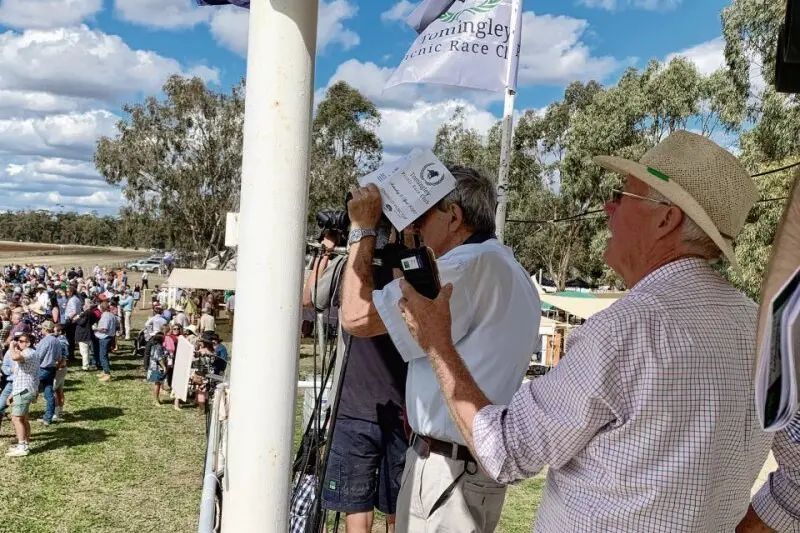
With more than 55 years as a race caller across the Central Districts and Western NSW, Colin Hodges is a respected opinion in horse racing.
So, we asked Hodges the question, how is bush racing going?
“The prize money has risen significantly over recent years,” he said.
“There are a lot more trainers around than I’ve ever seen.
“It’s still a hard game … but there are trainers finding they can make a living out of the game a little easier than they could in the past.”
Hodges said one issue is that major corporations have bought properties in Far Western NSW.
What this means is that volunteers that have run the race club have left town.
Hodges said another positive, aside from improved prize money, is the big crowds at country meetings.
He cited Louth, Bedgerabong and Duck Creek (Nyngan) as three meetings in smaller communities that are drawing massive crowds.
Hodges feel keeping the one meeting a year clubs going is crucial.
“People are embracing racing … a lot of young people are getting to the races again,” he said.
“I think it’s imperative to keep clubs going in remote areas as it’s a great social outlet for people.
“For a lot of those places, the race day is their biggest day of the year.
“When you lose that … you lose a great asset out of your town.”
•••
So many female jockeys today – when once there were none
Increase in female participation is one of the biggest changes Hodges has seen. When Hodges first started calling, females were not allowed to ride in races. Some pioneers included Margaret DeGonneville, Hodges recalled.
At first, females could only have exhibition races (no prize money or betting), and then there were only races for prize money and betting against other female jockeys.
Now, Hodges goes to meetings and 80 per cent of jockeys can be female.
“And they’re all outstanding,” Hodges said.
“Within the country, I go to so many meetings where there are more female jockeys, and they are very very good, too."
While some people believe horse racing is cruel to the thoroughbred population, Hodges said he believes trainers love their race horses.
“My experience over all these years is that race horses are the best looked-after animals I know of,” he said.
“All the jockeys, trainers and owners I know and see … they are in it to win, they are competitive, but the whole lot of them, they love their animals. They absolutely love their horses.”
•••
The future
Hodges, 75, intends to keep going.
“While I’m wanted, I’ll keep calling,” he said.
However, he noted it is a pressure-filled position, particularly with the advent of broadcasting and betting now going across the world.
“I’m calling for people across the world,” he said.
“There is a lot of pressure.
“Sometimes when I’m behind the microphone, I feel like I’m the person getting up to sing the national anthem, terrified they are going to forget the words.
“When I’m calling a race, there might be $100,000 in prize money, but there might be another $200,000 in bets, so I have a responsibility to get it right.
“It is a nerve-racking job. I’ve been doing it for 55 years and I still get nervous.
“You have to have some nerves, or you relax too much.”