
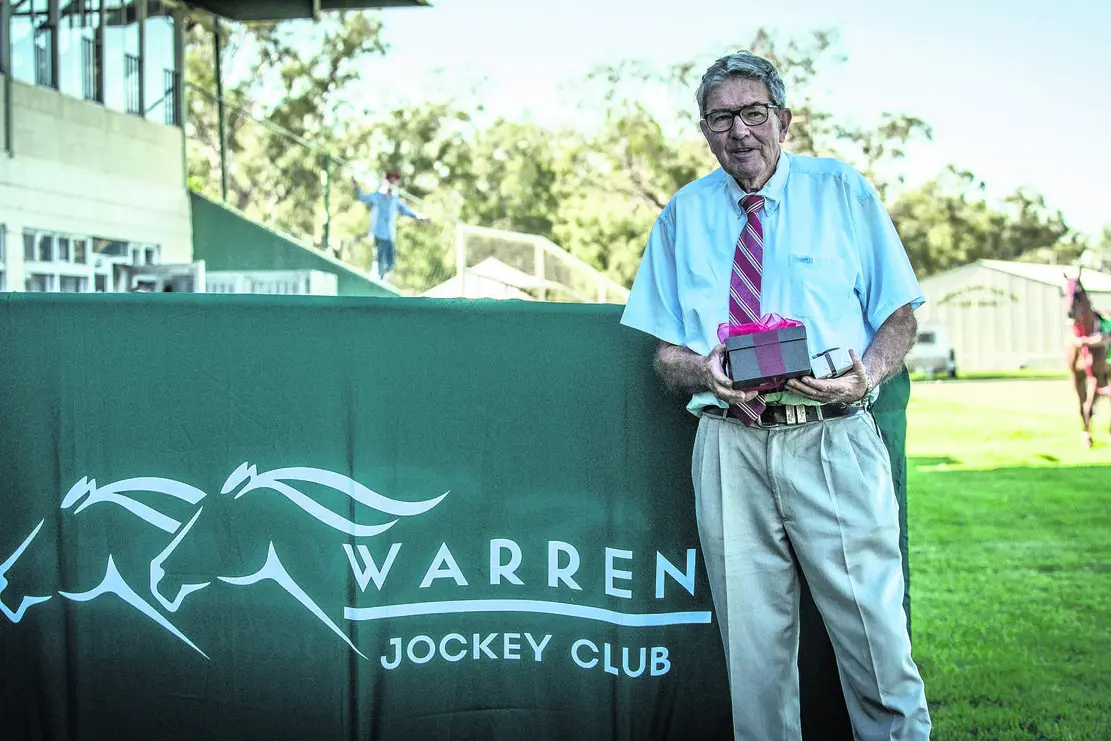
PHOTO
While there have been many facets to Colin Hodges’ life, his name is simply synonymous with horse racing.
Just as casual football fans associate a National Rugby League player’s name with his club or most famous exploit, for many people across the Central Districts and Western NSW, racing fan or not, mention Hodges’ name and one things pops up straight away – race caller.
Hodges grew up west of Forbes, and attended a one-teacher school at Gunning Gap.
When Hodges was in sixth class, there were three children in his year and 10 across the entire school.
He used to perform a phantom call of a horse race at the annual Christmas Tree.
Hodges also commentated kids’ footraces.
Born on a farm, he also grew up on the family property 18 kilometres from Bogan Gate.
He eventually ended up operating the property, growing wheat and running sheep, pigs and angora goats.
Hodges lived at Bogan Gate for more than 40 years before moving to Forbes.
He didn’t attend a race meeting until he was 14, at Bedgerabong, west of Forbes.
“I was absolutely fascinated when I saw these horses running past,” Hodges told Dubbo Photo News.
“We always had horses on the farm... and I rode stock horses... but to see these jockeys in their beautiful colours just perched up there, and the horses would come thundering past. I thought it was exhilarating.”
Next opportunity, he went to a meeting at Bogan Gate.
He remembers listening to great race callers of the time, Joe Brown (Melbourne), Geoff Mahoney (Sydney) and later on Ken Howard.
Hodges was fascinated by them. He started shooting marbles around, and giving those marbles racehorses’ names.
His first-ever call was a harness racing event at the Forbes show.
A horse Border Ridge won, driven by John Nealon from Grenfell.
Hodges’ first call of the gallops was on October 3, 1970 at Gooloogong.
He called one race on the card, won by Minibelle, which was trained by Dick Cornish and ridden by Bruce Gentle.
Hodges called the race from the back of a truck to assist long-time race-caller Bobby Gunn.
“Bobby gave me my grounding in race calling,” Hodges recalled.
Minibelle had a foal called The Fun Of It which won a lot of races in Sydney when trained by Ray Guy.
Hodges explained that in those days, most races were on Saturdays.
This meant there could be meetings at Brewarrina, Bathurst and Forbes, for example, all on the same day.
So this meant there were multiple race callers required.
It meant Gunn was short-staffed one day, so he sent Hodges to call his first full race meeting at Fifield.
The date was April 12, 1971. Gallant Combat won the first race. Trained by Tom McMahon from Tullamore, and owned by Tom and his wife Celie.
Tom and Celie have both passed away but their grandchildren are still racing horses in this area, in the distinctive pink colours with a pale blue sash.
How is Hodges’ memory so good?
“With race-calling, it’s not an easy job at all. You have to concentrate,” he said.
“But you also have to have a certain gift... where you can memorise things very well.
“I perform phantom Melbourne Cup calls, 24 horses, and I don’t use a script, and I run through the field three or four times.
“I can memorise things quickly from a newspaper.
“My memory is good... but gee I go to the supermarket three times in the one day, because I forget the things I was supposed to get.”
When a story was written on Hodges in 2017, his car had clocked up 332,000 kilometres.
That car got up to 500,000 kilometres, and Hodges got $120 for it at the wreckers.
His ‘new’ car already has 240,000 kilometres on it.
To differentiate horses, he will look at colours.
If colours are similar, he will look at the colour of a bridle or any other distinctive feature that can help him tell a horse apart.
He said the few minutes before each race when the horses are being prepared to settle in the barriers is his key time to learn about the horses.
• This is the first in a series about the life of Colin Hodges. See next week's Dubbo Photo News for the second instalment.