
PHOTO
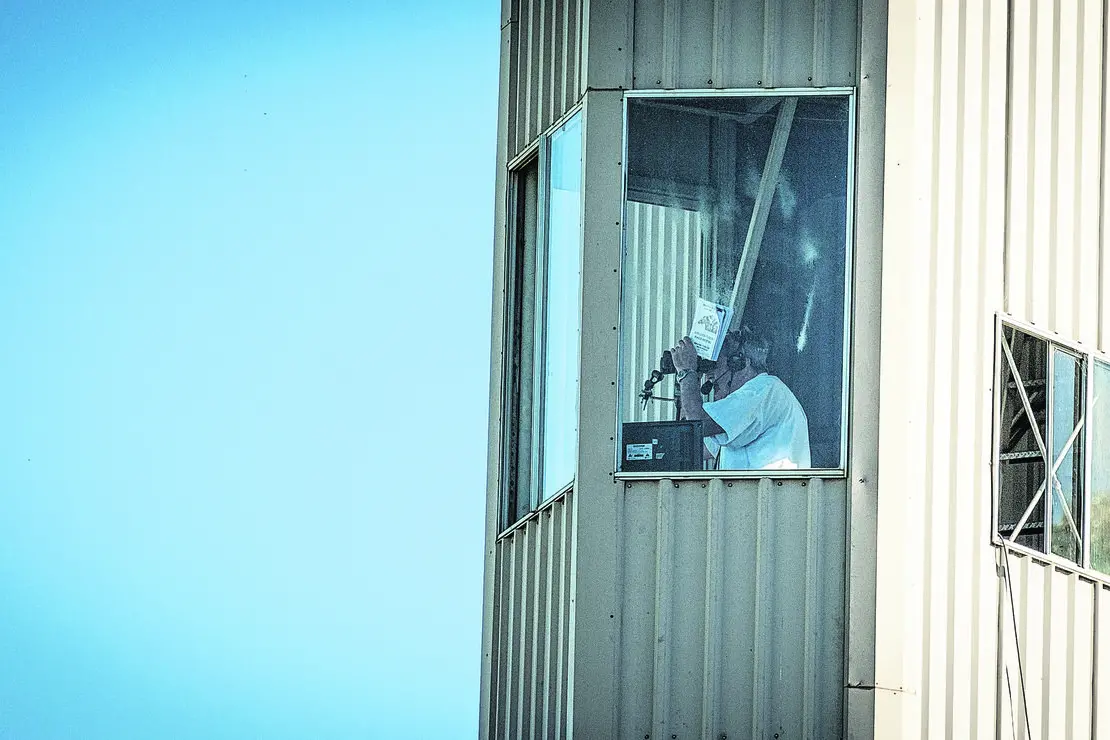
This week, we continue our series about racing legend Col Hodges.
While at 75, race calling has dominated his life, there are other facets to the man behind the microphone at the gallops across Central Districts and Western race meetings, Colin Hodges.
Between the ages of 19 and 49, Hodges was also a shearer and for the majority of that time he also operated a farm.
Early on, all three jobs were manageable, as he would shear or work on the property all week, and then call races on the weekend.
Shearing sheep at places like Quambone and Lake Cargelligo, Hodges was part of a team at Jemalong Station near Forbes where a team of 15 shearers sheared 40,000 sheep.
Hodges said of his shearing days that he learned how to work hard, be on time, and to not let your mates down.
He has carried that into permanent race calling, where he has never been late for a meeting, including one day when he needed assistance to get through floodwaters to make it to Bathurst.
“I juggled a lot of things back in those days,” he said.
The balance continued when took on a role with farm retailer Walker’s AGnVET, which began in Forbes and now has 90 stores across Australia.
In the evenings, Hodges would host functions and entertainment nights for the business across NSW.
Hodges once called everything... horses, trots and dogs.
There was also a decision to be made on what racing code Hodges should specialise in, as he was versatile there, too.
In his early days, he would call harness racing and greyhound racing, as well as horse racing.
However, the three codes started to clash, and he had to make a choice.
Hodges maintains gallops are the hardest to call because of bigger field sizes, more changes in positions during races, and that racetracks are much larger than harness or greyhound tracks.
“When you get say 14 horses coming out of barrier a long way away, they can look like ants, even with binoculars,” he said.
He recalls calling the Forbes greyhounds and how popular they used to be.
Hodges said there would be 10 bookmakers covering the local dogs, and three more bookies taking bets on Harold Park trots.
He recalls that those dogs were racing for a total prize money pool of $40 per race.
By contrast, Forbes now has a greyhound that just retired – Palawa King – owned by Errol Hughes and trained by Raymond Smith, that won 31 races from 77 starts to collect more than $1.1 million in prize money.
Across harness racing, he enjoyed calling Dimante Hanover, a pacer that won 34 of 113 starts in Australia and raced across the Central West, and also at Penrith, Melbourne, and Harold Park before finishing his career in America.
Within thoroughbreds, Hodges has enjoyed calling Gallant Star (six wins from 18 starts with eight minor placings for $768,530 in prize money as at August 10), which has former Test cricketer Kerry O’Keeffe as a part-owner with Dubbo’s David Ringland.
Smoky Dale, Atteates and Tullmax were some of his favourites.
Owned by Jack Cantrill, an Orange orchardist, and trained by Trevor Doulman at Molong, Tullmax didn’t race until he was six.
“I called a race at Parkes, and I thought, gee this horse is a bit different to the other horses I’ve been calling,” Hodges recalled.
“He went on to win I think, 10 of his next 11 starts, and had an amazing career which including winning Group One races in Sydney.”
Sniper’s Bullet, trained at Mudgee by Tracey Bartley, started his career around the Central West but went on to become a three-time Group One winner and from 57 starts accumulated an amazing $2,554,075 in prize money.
Rising Prince, who Hodges called early in his career, won the 1985 Cox Plate.
Vainscope, trained at Condobolin by Wally Evans and owned by Cec Moller, won 11 races as a two-year-old.
Hodges said the best two-year-olds win only two or three races.
“He was a marvellous little sprinter,” he said.
Of the tough horses, Hodges noted some determined triers.
Billy Bent Ear, trained by Connie Greig at Dubbo, was another. The 13-year-old just retired and raced 170 times for 20 wins and 51 minor placings.
Star of Universe, raced until he was 14, winning 21 starts from 196 races for Gulgong’s Percy Thompson.
Hodges explained most racehorses have between 30 to 40 starts.
Slip Top, the only horse trained at the village of Bedgerabong, won at 14 different tracks, and had an electrifying finish, Hodges said. Slip Top also lived to the age of 32.