
PHOTO
From a school dux who became a freedom fighter against the Japanese during China’s civil war, a Sydney representative footballer, RAAF officers in World War II, a human rights advocate and teacher, to the Education Department’s top position — the history of the local fifth form of a hundred years ago, makes fascinating reading.
With next year the centenary anniversary of Dubbo, Bathurst, and Orange high schools first competing against each other in the Astley Cup, district historian Patrick Bourke has provided an informative essay on the subject: 'Whatever Happened to the Class of ’25?'
By Patrick Bourke...
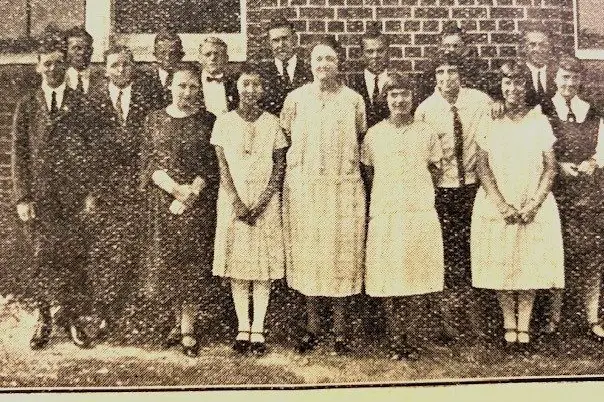
The 1925 Bindyite — the magazine of Dubbo High School — has a photo of the 1925 Leaving Certificate Class of 16 students in total; six girls and 10 boys. School captains were Harry Treverrow and Agnes Johnston, while the duxes (top students) were Treverrow and Mary Chong.
Whilst several of the students were from Dubbo Public, others came from primary schools outside of Dubbo, including Hugh Carson who went to the Brocklehurst Primary School; Vern Deacon from Warren Public School; with Treverrow from Canbelego Primary School, a mining village 50km east of Cobar.
Although this was the year that the Astley Cup was run as a tri-school competition between Dubbo, Bathurst, and Orange, the Cup had actually first been held two years earlier in 1923 as a one-off rugby league game between Dubbo High and the Sacred Heart College, Dubbo. Dubbo High won the match quite convincingly.
There was no Astley Cup in 1924 and, in 1925, it was reorganised with Dubbo, Bathurst, and Orange highs competing in five different sports — boys' football, mixed tennis, mixed athletics, girls' hockey, and girls' basketball. These sports were ones that the three high schools had already competed for in previously years.
The football code played in the 1925 Astley Cup was rugby union, while the girls’ “basketball” was actually netball, which had a name-change in the 1960s as American basketball grew in popularity. Dubbo High won the 1925 Astley Cup with several members of the Leaving Certificate Class competing including: Hockey — M Frost, L Gilmour, and A Johnston; Basketball — M Frost and A Johnston; Football — H Carson, K Fordyce, R Dunbar, H Treverrow, and V Deacon (Carson and Deacon had also been members of Dubbo High’s 1923 Astley Cup Football Team); Athletics — V Deacon and R Dunbar; and Tennis — H Carson, R Dunbar, A Johnston, and H Treverrow.
Subsequently, the Sydney Morning Herald of January 25, 1926, reported that 13 of the Dubbo High School students had passed the 1925 Leaving Certificate — the early 20th century equivalent of the Higher School Certificate — five girls and eight boys. The 1926 Bindyite reported that Mary Chong received several university scholarships: Senate of the University (Sydney University) Exhibition Scholarship, NSW State Bursary, and the Bundock Scholarship tenable at the Women’s College. Teacher Training Scholarships were awarded to Hugh Carson, Vern Deacon, Randolph Dunbar, Keith Fordyce, Ida Frost, Lorna Gilmour, Mary McLean, Henry Treverrow, and Agnes Johnston. Bursaries and scholarships were a common means at the time for students from moderate socio-economic backgrounds, to afford tertiary education, due to the then-onerous tuition fees charged by most institutions.
Vern Deacon subsequently became a prominent rugby league footballer who played first grade in the-then Sydney Rugby League competition for both the University and Balmain Clubs. This likely made him the first Dubbo High ex-student to do so.
He also played representative football in the NSW City firsts side against Country in the traditional annual match-up. He continued his football career successfully as a captain-coach in country NSW where he was also a teacher. Deacon would have got great satisfaction in how his home team, Warren, which he captain-coached in 1933, defeated arch-rivals Dubbo 2-0 in the Johnnie Walker Cup!
Mary Chong was famously the earliest-known second-generation Chinese Australian to graduate from an Australian university after being awarded dux of Dubbo High with her Leaving Certificate results included honours in Latin and A's in English, Mathematics, History, and Chemistry.
While in China, Chong co-edited the Shanghai English-language newspaper, the China Critic and worked for Dr Wellington Koo, China’s Ambassador to France, Britain, and a League of Nations delegate. She also joined the underground movement against the Japanese during World War II.
In 1957 Mary Chong, (married name, Wang) and Randolph (Randal) Dunbar were invited by the editors of the Bindyite to write messages to students. What they wrote was published in that year's magazine. Alma Mary Chong and Dunbar — who had become Director of the NSW Department of Technical Education — also both have entries on the ANU’s National Centre of Biography websites.
Chong wrote in Bindyite about her optimism about Australia, pleased that we were welcoming new migrants, had a growing appreciation for other cultures and, through the Columbo Plan, were training students from Asia.
Henry (Harry) Treverrow was also a teacher, working at Dubbo High for three decades. He received a fine write-up in the 1969 Bindyite at the time of his retirement. As noted in the school magazine: “Harry received a resounding farewell on his last day at the high school by parents, ex-students, teachers and students”.
Stan Davy, who had taught with Harry for 13 years at Dubbo High, also wrote a heartfelt tribute to Harry. Harry continued to attend the Astley Cup matches, especially the tennis. He was the coach of Astley Cup tennis teams for many years as well as being a geography teacher at the high school. Harry was the school’s sports master from 1951–1956.
Lorna Gilmour was another teacher who trained at Sydney University and Sydney Teachers College and taught at Hornsby Girls High School and then at high schools in Casino, Glen Innes, Kempsey, Richmond, Gunnedah, and Grafton. Gilmour was also a Teachers Federation representative at most of these schools and, at Gunnedah and Grafton, was secretary of the Teachers Federation’s committees. After returning to Sydney, where she taught at Willoughby and Burwood, Gilmour became active in the Secondary Teachers Association’s Professional Committee which included being a member of the Aboriginal Welfare and Environmental & Ecology committees. She retired from teaching at the end of 1972 after teaching for 15 years at the Fort Street Girls' High School.
Also, in 1972, Gilmour became a member of the Retired Teachers Association. After her retirement the Fort Street Girls’ High School magazine in 1973 gave a tribute to Gilmour which stated that she was “an enthusiastic geography teacher that brought to her classes her own considerable experience of overseas travel and travel throughout Australia.
“Her students were also enriched by her belief in the wider human implications of the subject. Lorna Gilmour was acknowledged as an untiring worker for causes such as conservation, Aboriginal welfare, world unity and the Freedom from Hunger Campaign.”
In retirement she devoted her energies to peace, social justice, and women’s rights, in particular with the Women’s International League for Peace and Freedom.
Gilmour, after her death in October, 2010, also received a warm tribute in the Journal of the NSW Public Teachers Federation’s magazine, after being awarded a life membership of the Federation in 1972.
From the group, Keith Fordyce, Robert Currie, and Hugh Carson, all became officers in the RAAF during World War II. Carson had been teaching at Grafton High School however, towards the end of 1942, he applied to enlist in the RAAF.
In the assessment it was commented that he was “a good type of officer” and had been working with the Air Training Corps (ATC) for three months in a civilian capacity. Hence, Hugh Carson was appointed as an officer in the ATC to provide military training to high school students who wanted to join the RAAF in areas such as morse code.
Fordyce was then promoted as founding principal at the new high school at Gunnedah in 1955 after being deputy headmaster at Kempsey High School. He was also head master at Grafton High School from 1961–62 and involved in the arts and rugby league.
In 1963, Fordyce was appointed the principal of the Coffs Harbour High School and held this position until 1969 when he retired from the NSW Department of Education.
Ironically, his successor in the position was a Clive Ward who, while a mathematics and sports teacher at Dubbo High from 1945–1951, successfully pushed for a change in the football code played in the Astley Cup from the traditional rugby union to the more-popular rugby league.
Ward’s ties to this 1925 group of Dubbo High alumni were many and varied. Both Ward and Deacon both played first grade rugby league for University in the Sydney Rugby League competition, Clive from 1929–1931 and Vern from 1926–1928, and both also played in the prominent rugby league annual match between the University of Sydney and the University of Queensland.