
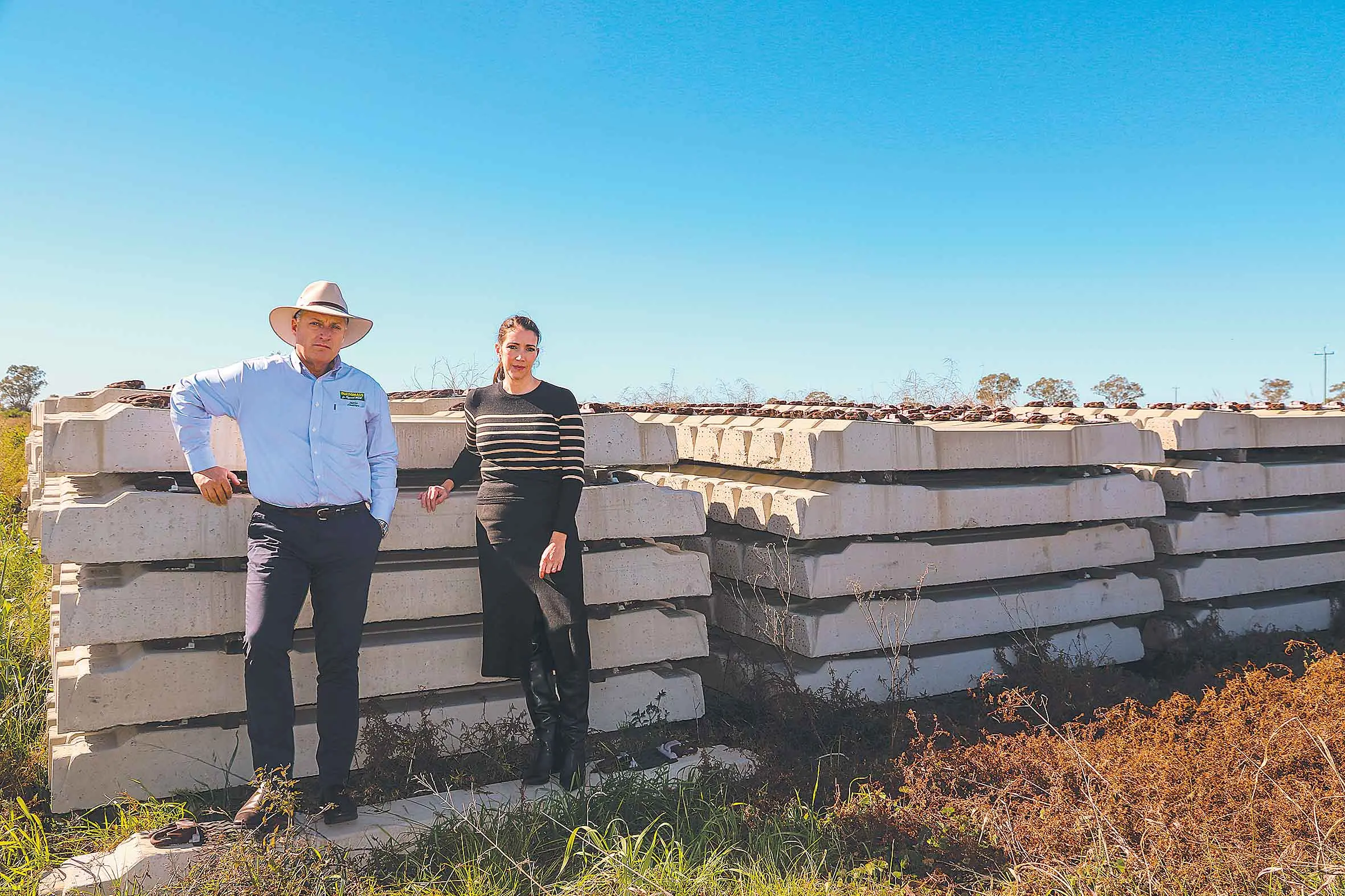
PHOTO
The Federal Labor Government announced last week it was shelving the monumental Inland Rail infrastructure project, sending shockwaves through regional Australia.
Politicians, local government, business, industry, agricultural groups and other stakeholders were quick to denounce the announcement by federal Infrastructure, Transport, Regional Development and Local Government Minister Catherine King on Wednesday, May 6.
Amid a flurry of high-dollar commitments to support Australia’s rail freight network was the minister’s announcement that the government would “consolidate” the Inland Rail project by completing construction in Parkes by the end of 2027. The rail corridor north of Parkes is set to be “preserved” – but what that means is unknown.
The completed line between Parkes and Beveridge, Victoria, will enable double-stacked freight trains to travel between Melbourne and Perth, via Parkes, Minister King said.
•••
Schott report crucial in decision
The project’s cancellation followed an April 2023 review of the Inland Rail development led by Dr Kerry Schott that said that the cost of delivering the project had “blown-out” to $31.4 billion.
In 2020, the project's estimated cost was $16.4 billion with a completion date of 2026–27, however, this had grown to a projected $31.4bn with an expected completion date of 2030–31.
The minister indicated an independent report confirmed the cost estimate now exceeds $45 billion to deliver the full Inland Rail project from Melbourne to Brisbane.
“This is more than three times the current budget allocation and this work also confirmed that the project cannot be delivered until at least 2036,” her statement continued.
•••
Not finished but well advanced
According to the latest available information from Inland Rail, the 1600km project with 12 sections to it has been completed from Victoria as far north as Narromine, and the section from Narrabri-to-North-Star Phase 1 is fully operational.
The Narromine-to-Narrabri part of the project was to be Inland Rail's longest section of track. In late February 2023, the Australian Rail Track Corporation (ARTC) received approval from the NSW Minister for Planning to progress that section, subject to conditions and Federal Government approval.
This part of the project would comprise approximately 306km of new rail corridor and track. When completed, it would enable freight trains to connect with the Narrabri-to-North-Star section and the completed Parkes-to-Narromine section.
•••
LGAs and business heavily impacted
The federal announcement impacts NSW and Queensland, in particular, with multiple Local Government Areas (LGAs) and local businesses along the proposed route from Melbourne to Brisbane having already invested heavily in supporting activity around the “nation-building project”.
One of those NSW LGAs impacted is Narromine Shire, which supported the development of land south of the town for the construction of a Materials Distribution Centre by Inland Rail at Narwonah, with adjacent land flagged for the creation of a major industrial estate that would have direct access to the Inland Rail network.
In a statement, Narromine Shire Council said it was deeply disappointed by reports that the Inland Rail project has been shelved.
“This decision will impact the future of the Narromine Region. Inland Rail was expected to deliver investment, jobs and economic growth.
“Narromine Shire Council, local businesses and the community have supported the project for many years, with the expectation it would be completed. Changing direction now creates uncertainty and undermines confidence in major infrastructure commitments,” the statement indicated.
Narromine Shire mayor Cr Ewen Jones said regional communities deserve clear answers.
“We need direction on the future of this project. Council and the business community have invested a lot of time, money and trust into Inland Rail and our region deserves to know exactly what comes next,” he said.
Dubbo Regional Council mayor Cr Josh Black said that the decision locally would mostly affect independent wholesalers whose services will now no longer be required.
“It’s more suppliers who will be impacted, rather than people from Dubbo doing the work,” Cr Black said.
“The contractors who provide the materials that would have gone into the project will be hit hardest locally. I’m not sure whether the work has started further north, but I understand they’ve already bought land corridors,” he added.
The termination of the project at Parkes is simply another indicator of the city-centric views of our politicians from all sides of the parliament, he said.
“It speaks more to the raw deal that that regional Australia gets, more to the symptom that all the money goes to the capital cities, and we get the scraps,” Cr Black observed.
“That view goes for pretty much for all governments in Australia,” he added.
From a region seriously affected by the cancellation of further works, Narrabri mayor Cr Darrell Tiemens echoed Cr Black’s observations.
“I think all the mayors up and down the line are concerned about it. I would very much agree that here in Australia rural areas are overshadowed by our bigger cities like Sydney and Canberra,” Cr Tiemens said.
“It’s a wasted opportunity to create a real nation-building project, one that would have facilitated transport of our food and fibre up and down the east coast so much more efficiently, while removing heavy trucks from our roads,” he added.
With much of the land for the project already purchased for the rail corridor, he believes that a future government will almost certainly look to start the work again.
“I think it’s absolutely true, people keep talking about improving our productivity, well, the two things we are world leaders in, are mineral exports, and agriculture,” Cr Tiemens said.
“The transport issues aren’t going to go away, nor will the need for us to freight our agriculture more efficiently in the future. I believe it will be finished at some future date, but at what cost?” he concluded.