
PHOTO
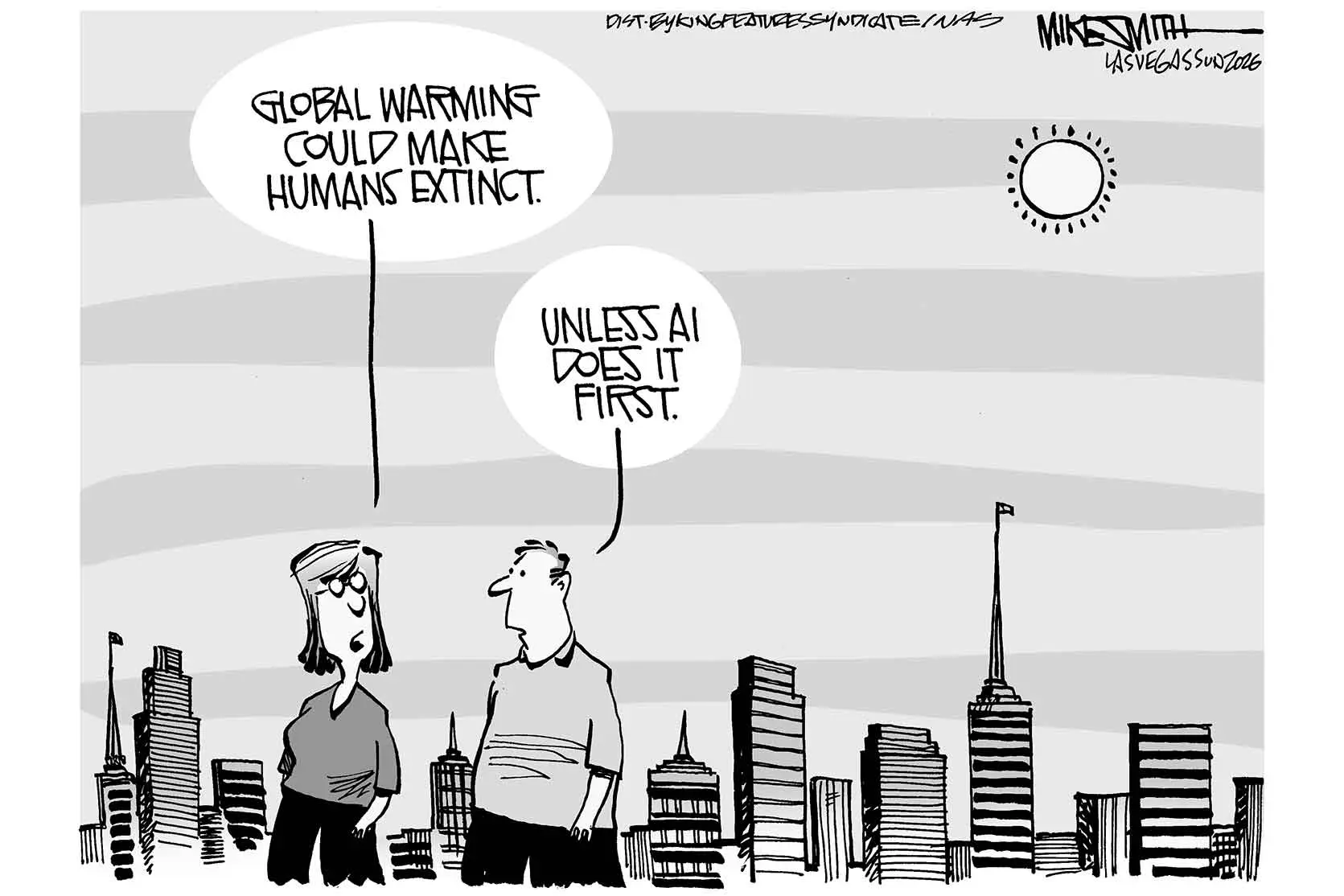
Like many people, I find looking into our AI future both exhilarating and terrifying.
The promise is extraordinary. Faster cures for disease, a step-change in productivity and lower costs for the goods and services we rely on. Few technologies have offered humanity so much.
The fears are just as large. Some imagine a Terminator-style takeover by machines. Others worry about colossal wealth and power concentrating in a handful of corporations or authoritarian states. ASIO chief Mike Burgess has now added another warning that Australia's data centre boom is exposed to foreign interference.
But as is so often the case, the sensational debates that dominate headlines can provide cover for quieter changes with lasting consequences.
One of these is copyright.
There is a respectable argument that laws written for the printing press and photocopier don't fit a technology transforming the 21st century. The Federal Government is under genuine pressure to act. The tech industry's peak body has urged the Attorney-General to amend the Copyright Act. The Productivity Commission canvassed a text and data mining exception in its interim report, though its final report concluded it was premature to change Australia's copyright laws.
But the pressure hasn't gone away.
It's easy to see the temptation. Global AI firms are spending hundreds of billions on data centres and research. Every government wants a share of the investment, jobs and tax revenue.
The pitch, essentially, is that if we loosen our copyright rules – and let's be clear, "updating" here means weakening – Australia can be for AI what the Cayman Islands is for tax.
But is that the Australia we want? Investment at any cost? If the price of attracting AI investment is legalising the taking of other people's intellectual property, are we really better off?
Consider a farming analogy.
Imagine spending months preparing your land, planting a crop, buying fertiliser, maintaining machinery and paying workers. Then, just before harvest, a large company arrives with technology no farmer has ever seen. It doesn't drive a header through your paddock. It doesn't touch a single grain. Your crop is left standing exactly where it was. Yet the company walks away with everything that crop was worth and starts selling it to your customers. The company says it has done nothing wrong. Your crop is still there. Go ahead and harvest it.
But who will buy it?
Your customers are already being fed elsewhere – at the AI market, under its roof, on its terms. The crop in your field and the grain in your silo are untouched but are now worth next to nothing.
Now imagine being told that if you didn't want this to happen, you should have put special signs on every paddock. Or that the company could pay into a general fund, and you might eventually see something from it.
No farmer would accept that. Nor should they.
And the principle extends well beyond farming or journalism. Whether it is a photographer who takes a picture, a musician who writes a song or a publisher who pays a journalist to investigate a story, someone has invested time, skill and money in creating something of value. Technology making that work easier to access does not remove the creator's right to control its commercial use and negotiate a fair return.
That principle is now at the centre of a major debate about Australia's copyright laws and the use of Australian material to develop artificial intelligence.
Australia has long taken copyright protection seriously. We also helped lead the world with a bargaining code that gave news publishers the leverage to secure deals with major digital platforms. That reputation should be an asset in the AI era, not something to trade away.
Former ACCC chairman Rod Sims, one of the architects of the News Media Bargaining Code, has warned against Australia becoming a haven for copyright infringement. His experience demonstrates that governments can encourage innovation while insisting on fair commercial arrangements.
The Federal Government has made welcome commitments. Attorney-General Michelle Rowland has ruled out a blanket text and data mining exception, while Prime Minister Anthony Albanese has said creators must retain control over the value of their work. The test is whether the final policy honours those commitments.

Some options under discussion would weaken rights by stealth, with opt-out schemes, payment pools or automatic access once a developer has signed a prescribed number of deals with others.
A small regional newsroom can't employ engineers to block every AI crawler and prove that silence wasn't consent. Nor should a payment pool become a substitute for negotiating with identifiable owners. No company should be entitled to use our journalism simply because it struck a deal with somebody else.
Country Press Australia represents around 240 independent local and regional newspaper mastheads.
Our members invest every week in reporters who sit through council meetings, scrutinise public spending, cover courts and emergencies, and tell the stories national outlets rarely will. That work costs money.
When AI systems take our journalism and serve it to readers inside their own platforms, those readers no longer need to come to us. Publishers risk losing readership and advertising revenue while also losing the opportunity to develop licensing income from their reporting. Our crop is still in the field. Its value has been harvested by someone else.
For smaller regional publishers already facing rising costs, that could mean fewer journalists, less scrutiny and eventually no newspaper at all.
There is also a wider public cost. AI can summarise a council investigation, but it cannot conduct one. AI systems need reliable, current information, and somebody must first pay to discover, verify and publish it. If the newsrooms producing original journalism disappear, AI cannot simply invent the next council investigation or local court report.
There is a better way.
Publishers are identifiable. Collective bargaining can reduce thousands of negotiations to a handful. One commercial agreement with Country Press Australia could cover hundreds of mastheads. Where parties can't agree, independent mediation or arbitration can help resolve disputes.
That gives AI developers a clear, legal pathway to licensing and returns revenue to the people who create the content. It supports innovation without requiring Australian businesses to surrender their rights.
Country Press Australia supports AI.
Our members are already exploring and using its opportunities. But a new data centre or promise of jobs is not fair compensation for giving up a valuable Australian commercial right.
The warnings from Mike Burgess and Rod Sims concern different risks, but both remind us that technological opportunity is no reason to abandon sound safeguards. As Australia races to attract investment, we should ask not just how much wealth it might create, but who controls the assets that create it and who ultimately benefits.
Australia can welcome artificial intelligence and protect the businesses, jobs and communities that create its value. Those goals are not mutually exclusive.
We wouldn't let anyone take the fruits of a farmer's labour simply because they'd found a more sophisticated way of harvesting.
We shouldn't allow it for journalism either.
* Damian Morgan is President of Country Press Australia representing independent local and regional newspaper publishers across Australia. This masthead is a member of Country Press Australia.