
PHOTO
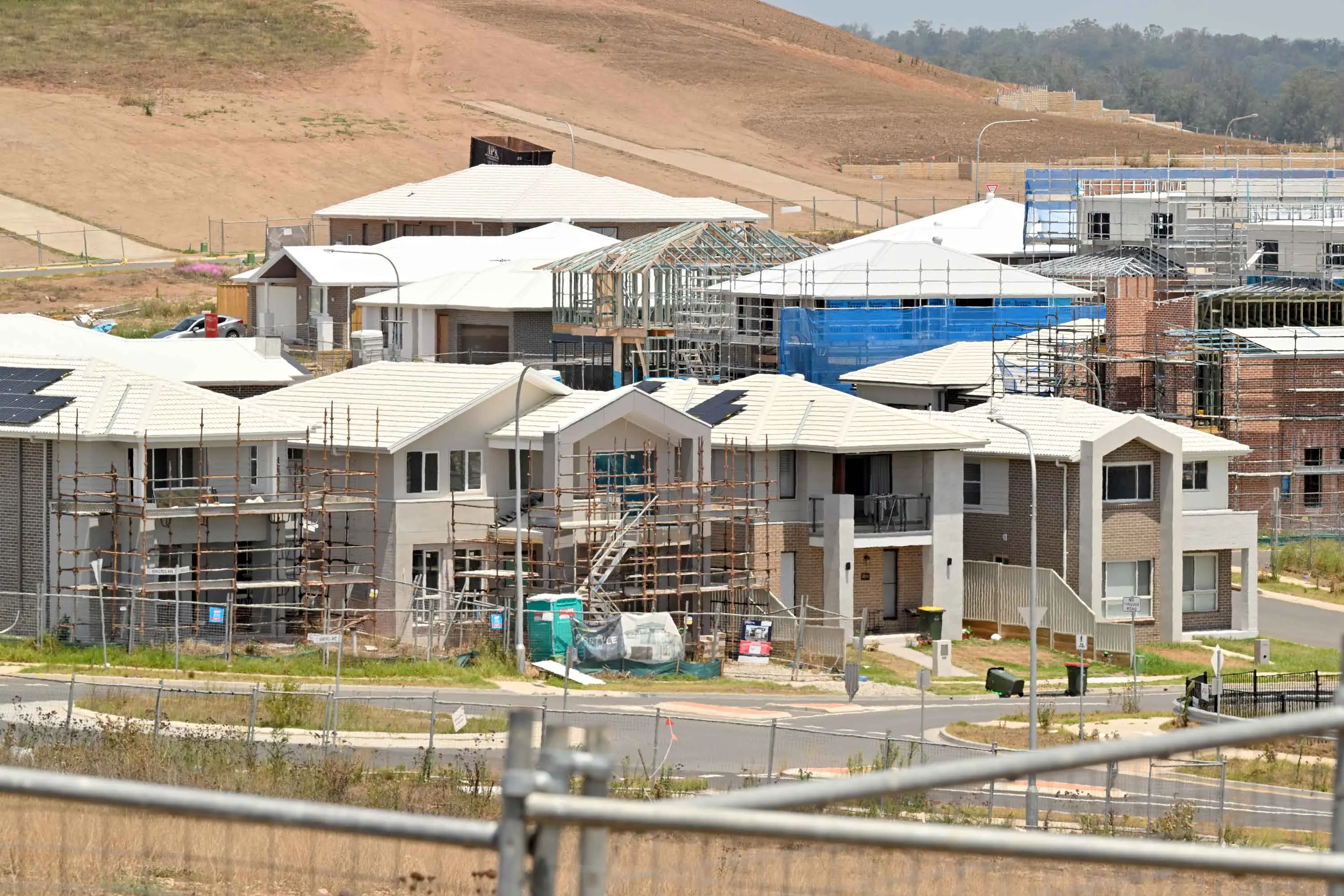
Australia continues to fall further behind on its ambitious target to build 1.2 million new homes in five years, fresh data will show.
In an otherwise economic data-light week, building activity figures will be released by the Australian Bureau of Statistics on Wednesday.
Although sentiment in the property market has taken a dive following three rate hikes, rising unaffordability constraints and changes to investor tax breaks, construction is expected to keep strengthening.
Construction started on more than 53,000 homes in the December quarter, up eight per cent on the previous quarter and 26 per cent on the 12 months prior.
Dwelling commencements will likely keep trending up in the March quarter, said Tom Devitt, senior economist at the Housing Industry Association.
Dwelling completions are also expected to rise but by nowhere near enough to meet the national housing accord target.
About 173,000 homes were completed in 2025.
To meet the target, the sector needs to build 240,000 homes per year.
"Our forecasts have them well under," Mr Devitt told AAP.
"In fact, HIA has just released its own report estimating how many homes we need on a sustained basis, not just to meet population growth, but to also meet shrinking household sizes... and to actually start making a dent in the pre-existing shortage.
"And the number we came up with was 250,000 homes per year."
There was still more to do but construction times have improved, with new homes being built 10 per cent faster than when the accord started in July 2024, a spokesperson for Housing Minister Clare O'Neil said.
"Fixing a problem generations in the making takes time but we're seeing good progress in housing supply across the country with more homes being approved, more homes being built, and, importantly, they're being delivered faster," they said.
Wednesday's data will take in one month of the Middle East conflict, which caused fuel costs to surge as the Strait of Hormuz closed to oil tankers.
At the time, economists warned construction expenses could spike up to 10 per cent.
But Mr Devitt said those fears have not been borne out.
"Anecdotally... it's more like one per cent; a few $1000 added by fuel costs and other isolated supply constraints as a result of the Iran war, which isn't nothing but it's relatively limited," he said.
Even if there is a building slowdown due to rate hikes, curbs to negative gearing and the capital gains tax discount, the fundamentals for housing – strong population growth, tight labour markets – are still very strong.
"Once this uncertainty clears, the limitations on activity will really be things like interest rates and the extent to which policymakers can bring land and infrastructure to market, so that housing can actually commence," Mr Devitt said.
More clues for the future path of interest rates could come on Wednesday, when RBA chief economist Sarah Hunter delivers a speech to the Australian Conference of Economists in Canberra.
Wall Street investors are meanwhile looking to next week, with US indices closed for the Independence Day break on Friday.
Semiconductor stocks and other AI-linked companies fell on Wednesday and Thursday, with financials and healthcare shares favoured, among others.
Australian share futures dropped back surged 35 points, or 0.39 per cent, to 3,890.
The benchmark S&P/ASX200 index on Friday rose 119.9 points, or 1.37 per cent, to 8,844.4, while the broader All Ordinaries grew by 117.4 points, or 1.31 per cent, to 9,048.3.