
PHOTO
By David Dixon
Local activist Joe Flick’s current project, working on a documentary about western NSW Aboriginal war hero, William Allan Erwin DCM), highlights the often-unrecognised role that Indigenous Australians have played in our armed forces.
The Netflix film Bringing His Spirit Home is partly-inspired by a Churchill Fellowship trip in 2022 in which Mr Flick uncovered the stories of 91 Aboriginal soldiers who perished in battle or succumbed to wounds or illness during World War I.
Dubbo historian Patrick Bourke has also chronicled the experiences of one local man who signed-up to serve his country at a time when most Aboriginals suffered continuing discrimination and were often denied service in hotels and clubs, despite their war service.
“Some years ago, I was able to identify the World War I soldier George Collins, whose name is on the Bodangora War Memorial and Wellington War Memorial, as an Aboriginal soldier. My great uncle George Bourke is also on these two war memorials,” Patrick said.
“George Collins who died from his war wounds in the Middle East, and George Bourke who died in action on the Western Front, have no known graves... very likely the Collins children and Bourke children went to the same small schools at Windora and Comobella in the Geurie/Wellington area during the 1880s and 1890s,” he added.
This was at a time when Aboriginals still suffered a great deal of institutionalised discrimination in Australian society, probably one of the reasons why their race was often downplayed by military officials when they enlisted.
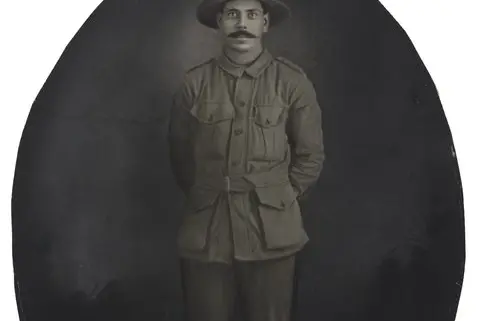
“George Collins was a World War I Indigenous soldier from the Wellington area who enlisted in Dubbo during 1915, but who was not noted as Aboriginal,” Patrick said. “This was not unusual, George in his 1915 enlistment papers was only described as being of ‘a dark complexion’, his Aboriginal heritage is through his grandmother, a full-blood Aboriginal woman known as ‘Diana Mudgee’ as she lived in the Mudgee area."
Listed as a labourer, Collins died of wounds in August 1916 while serving with the Seventh Light Horse Regiment at the Battle of Bir el Abd against the Turks of the Ottoman Empire on 9 August, 1916.
For the Indigenous men who signed up and survived, Mr Flick -- in an essay for his sponsors, the Churchill Fellowship -- noted that the discrimination did not end after they returned to Australia.
“When Aboriginal solders came home, they were treated differently: my grandfather wasn’t allowed into the RSL to celebrate Anzac Day, he was told to ‘go around the back and they would hand him a beer’, these stories aren’t known or talked about.
"When my grandfather came home, his kids weren’t allowed to go to school — not until 1947, the majority of Aboriginal soldiers weren’t provided with soldier settlement land blocks either,” Mr Flick wrote.
On his trip, Mr Flick conducted a small ceremony at each of the found 68 graves by draping the Aboriginal flag across each of the headstones during the ceremony, laying flowers, and left both an Aboriginal and an Australian flag at the grave.
“It is a little-known fact, that more than 1200 Aboriginal men enlisted in World War I. Without them, and without all of our Australian solders, we wouldn’t have the freedom we have today,” he added.
Where details were known, Mr Flick also read out the names and acknowledged family details as well as playing the clap-sticks to honour the too-few years these young men lived.
The playing of clap-sticks is a means of returning a spirit to country, family and the dreamtime. Each ceremony was finished with a recitation of the Ode of Remembrance and playing of The Last Post, to commemorate the men who have no known graves but whose names are commemorated on memorial rolls.
“It was an emotional trip, standing in front of the graves of these young men, from Cape Barren Island, and from some of the Aboriginal missions in NSW and Victoria,” Mr Flick wrote. “I told them that their mob loved them, and their mob know where they are, I know a lot of their people won’t get to visit those cemeteries.”
A Gomeroi man, William Allan Irwin was born in 1878 on the Burra Bee Dee Aboriginal Mission, near Coonabarabran.
In August 1918, William’s company was involved in intense fighting near Mont St Quentin. The battalion was trying to get control of German-held positions at Road Wood, where they faced intense German machine-gun fire.
William’s colleague Private George Cartwright charged one of the machine-guns, capturing it along with nine prisoners. William then captured three enemy machine-gun posts and their crews, one after another. When he tried to capture a fourth, he was severely wounded in his back and thigh. He died the next day, on September 1, 1918.
William Allan Irwin was buried in the Daours Communal Cemetery in France. He was the only Aboriginal soldier identified by Charles Bean in his opus, Official History of Australia in the First World War.