
PHOTO
There's a saying on the Weston brothers' property: "Every day it doesn't rain is another day closer."
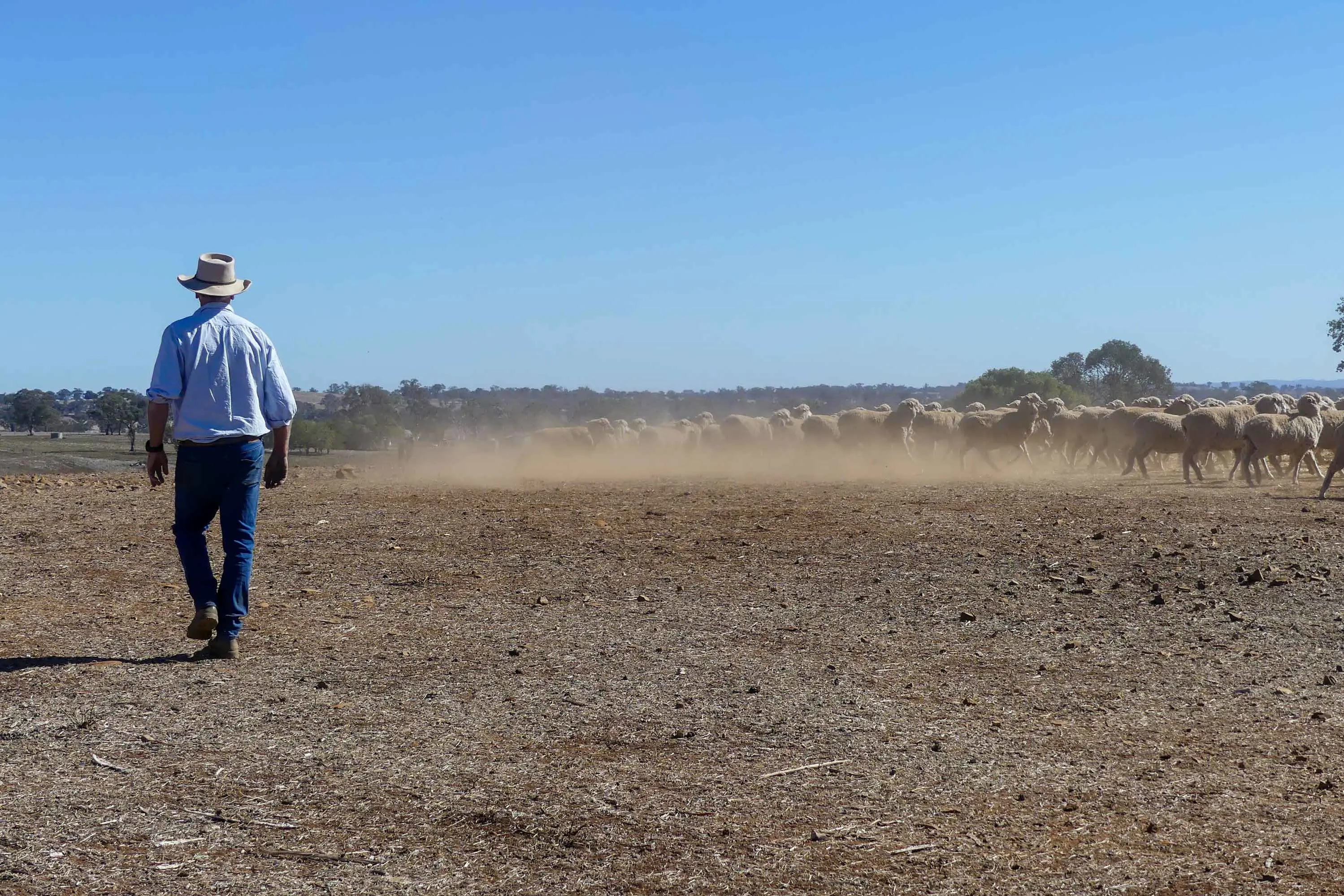
"So tomorrow is another day closer to rain, isn't it?" farmer Mark Weston tells AAP, after a long morning spent feeding sheep under the unseasonably hot autumn sun.
That wisdom was passed on to Mark and Dave Weston from their father, who raised them on the family's expansive sheep, cattle and cropping operation at Cumnock, in central western NSW.
The fifth generation farmers are holding onto that philosophy as they approach winter, with no decent rainfall for more than six months.
Cumnock, south of Dubbo, is on the edge of a vast swathe of inland NSW considered drought affected, with the dry stretching into parts of southern Queensland.
Wheat and canola crops that would usually be knee-high and open for grazing by late autumn are struggling to emerge from the parched earth, while the brothers feed their sheep and prepare to sell off cattle.
Crop stubble covers the property, as mobs of Merinos kick up dust in their rush towards generous drops of hay and barley.
"Everything revolves around rain. Everything," Dave Weston says.
"It's trying times."
Like farmers right across Australia, the Westons are grappling with what the season throws at them while also factoring in the unpredictable price and supply of fuel and fertiliser.
Some of the Westons' decisions – such as feeding sheep in containment yards to keep the animals healthy and rest their paddocks – are informed by previous dry seasons.
The brothers quickly stocked up on diesel in the days after the Iran war broke out and were thankful for their stores of urea.
The price of the fertiliser, which Australia largely imports from the Middle East, has nearly doubled to $1400 a tonne and won't go out on any crops this season.
Plans for growing pasture will be delayed for a year.
"You've just got to deal with what's happening every day," Mark says, emphatically.
"You can't let it worry you too much, otherwise it'll get you down."
Farmers in NSW and Queensland are rapidly de-stocking, with the Bureau of Meteorology's long-range forecast warning rainfall is likely to be below average for much of eastern Australia between May and July.
There have been record cattle sales at yards in both states and online agricultural marketplace AuctionsPlus has experienced a dramatic spike.
More than 20,000 NSW Northern Tablelands cattle were offloaded on the platform in April, with demand from buyers in Victoria, South Australia and Tasmania as dry conditions ease in the southern states.
While drought is the key driver, the record online sales figures show producers are finding ways to avoid the higher costs of trucking stock to yards, chief executive Wyn Snyman says.
The rush to de-stock while prices remain strong also reflects lessons learned from the 2017-19 drought.
"Producers who tried to stick it out as long as they could ended up selling into quite crowded markets and then they were just price takers," Mr Snyman says.
"So a lot of producers are already planning forward."
Northern NSW grazier Andrew Baker has only received a little over 40mm on his properties in the first four months of the year, after recording 150mm below average rainfall in 2025.
Mr Baker has sold off 250 cattle and will begin feeding the remainder over the next few weeks.
He has been looking at setting up a reticulated water system on his land near the NSW-Queensland border, but the fraught global oil supply has affected the manufacture of plastic tanks and poly pipes.
For now, he is spending much of his time looking out for livestock and wildlife stuck in his muddy drying dams.
"You hear of all the rain up in Queensland, the cyclones coming through, floods on the coast... but I don't think people realise how dry it is in places out this way," Mr Baker says.
"It's getting a bit hard out here."
Western Australian farmers are carefully considering their cropping mix and the expanse of land to sow, as the availability of fertiliser in the largest state remains uncertain.
The cost of freight went up by $1 per tonne per week in March due to diesel prices, Pastoralists and Graziers Association of WA president Digby Stretch says.
But farmers have been here before, after Russia's invasion of Ukraine in 2022 raised similar fuel and fertiliser concerns.
"We will all be looking at carrying more fuel and more liquid fertiliser on hand in years to come to cushion us from these sorts of risks," Mr Stretch says.
"And we are absolutely going to be working hard with governments to try and get something better than the three- to four-year electoral cycle vision they have going."
This ability to move with the conditions is deeply ingrained in Australian farmers, Mr Snyman says.
"They are really at the forefront of change," he says.
"Climate is changing on them, prices change on them, inputs change on them, the regulatory environment changes on them.
"The one thing they're constantly exposed to is how they keep reacting to these changes... I take my hat off to these producers."