
PHOTO
Reducing waste more than just a sightliness issue
Most public policymakers understand that reducing dumped rubbish and waste in the community has benefits far beyond just general sightliness and an orderly appearance.
With this in mind, council is currently supporting two "keep Dubbo clean" initiatives designed to reduce rubbish in the region, but which could also have a range of other benefits.
Human behaviouralists describe the importance of maintaining public cleanliness and order as the "broken windows theory" — the idea that small signs of urban neglect can be linked to a sense of general abandonment and, ultimately, increased crime in major cities.
With a regional centre like Dubbo, one might instead call it the "dumped trolleys principle": the phenomena whereby the more shopping carts strewn around a car-park, the less likely shoppers are to return theirs to the assigned bays.
The first of council's new initiative involves residents being encouraged to swap single-use plastics for reusable alternatives as part of Plastic Free July.
Council is also asking residents to think beyond what they normally do in their day-to-day lives and, during July, add something else in.
The second scheme involves waiving tip fees for community groups doing clean-up of waste in the region.
The Community Clean-Up Fund will allow local organisations accessing Council's waste facilities free of charge when undertaking approved litter clean-up activities across the region.
As a landscape gardener who likes to keep things neat and tidy himself, Cr Lukas Butler said that illegal dumping of rubbish lends a bad feel to a community and should be cleaned up as soon as possible.
"Wellington has had two big dumps recently involving car tyres, mattresses, even a car body; one at Nanima Hill just up from the tip, and the other one on the Bell River off Burrendong Way," Cr Butler told Dubbo Photo News.
"I do think if a place is left looking untidy, it is inviting more untidiness, so I think that this stuff being collected in clean-ups is really important," he added.
An old hand at waste recycling himself, deputy mayor Phillip Toynton said that abandoned rubbish is a major cost to Council each year as well as an encouragement to further dumping.
"I used to work at the tip, and you'd have the Council clean-up crews most days coming in with illegally dumped rubbish to the transfer stations. The amount of waived fees alone would be in the tens of thousands of dollars," Cr Toynton estimated.
"Also, if it looks like no-one cares about an area, people think, 'what's one more old truck tyre or bag of rubbish?' I think anything that helps mitigate the amount of plastic bags that don't decay and garbage dumping is a good thing," he believes.
He says that the introduction of coin-operated trolleys for most supermarkets in town has seen a noticeable drop in dumped shopping carts.
"I think so. You need some kind of financial incentive; it appeals to people's fear of missing out and also encourages compliance.
"If people see everyone else is returning their trolleys, they are more likely to do so themselves as well," he concluded.
Talking of shopping, Councillor Richard Ivey said that some of our major shops should be doing a bit more heavy-lifting when it comes to reducing litter.
"One of the worst major areas for general rubbish is around our two major supermarkets. They are untidy, a real mess," Cr Ivey argued.
"Council can lead the way with these incentive programs, but others have to lend a hand as well. It's not all down to us.
"Introduction of coin-operated shopping trolleys is an example of a practical way for businesses to reduce dumping in the community," he concluded.
Keeping the region clean and tidy also offers direct economic benefits by creating a welcoming impression to visitors and potential new residents, Councillor Shibli Chowdhury believes.
"Absolutely, people coming to town from, say, Orange and seeing it's tidy gives a good impression and they're more likely to spend time here," Cr Chowdhury said.
"Also, if you're thinking of establishing a business here, first impressions of a community have a really big impact on those decisions. That's why the coin-operated shopping trolleys have made such a big difference," he added.
•••
Another blaze trashes garbage truck
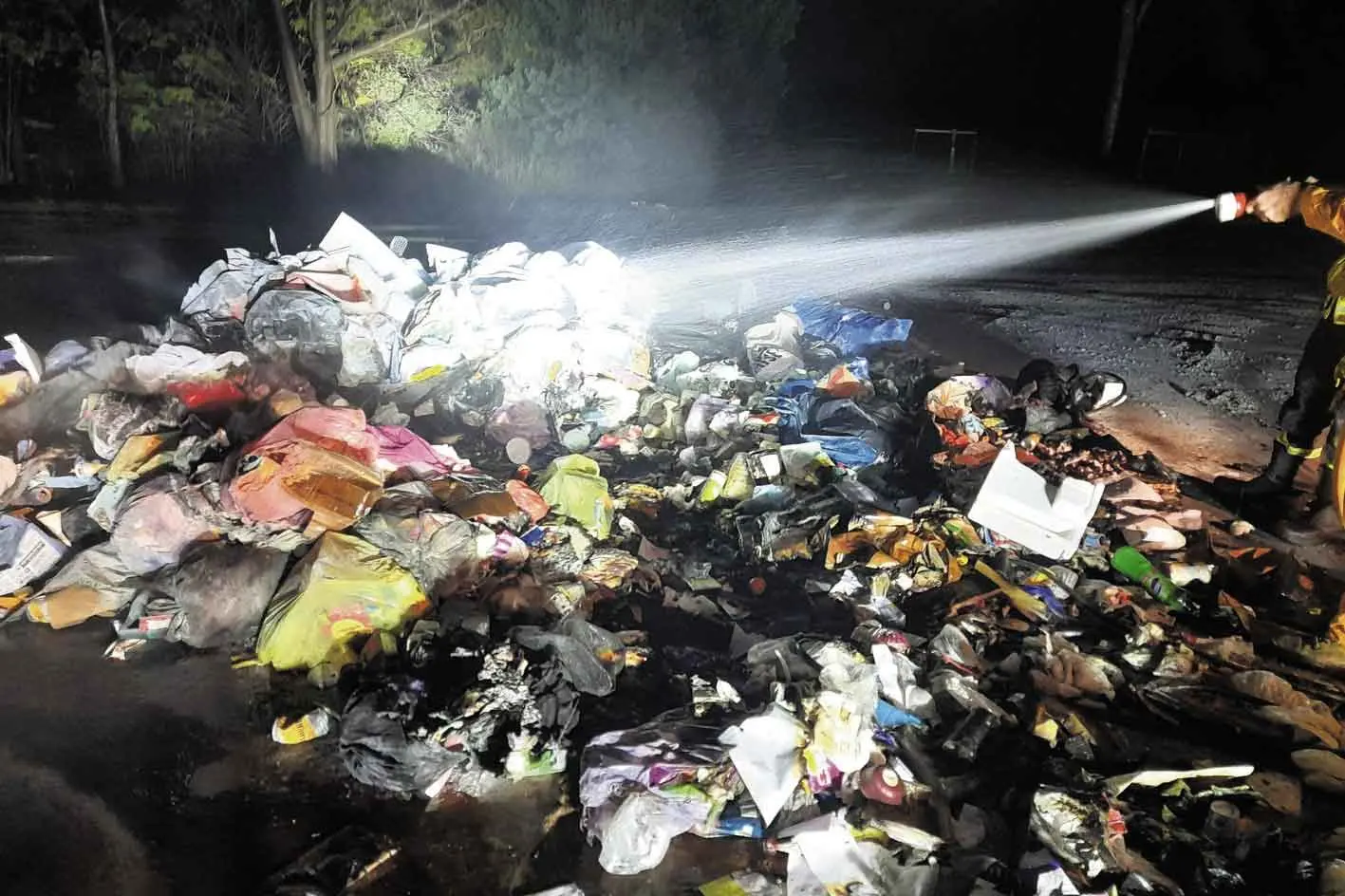
It's happened again. Another blaze caused by an embedded battery device put a garbage truck out of commission last Thursday morning on a domestic kerbside collection run along Lonsdale Road, Minore.
The driver emptied the load and NSW Fire and Rescue attended to extinguish the fire, as Council's Resource Recovery and Efficiency Manager Luke Crittenden urged locals not to dump old battery-powered items into their bins.
"Garbage trucks are high-value assets, not just in the cost to replace them, but the service they provide to our community," Luke said.
"We had a similar situation in August last year when a truck driver had to empty the load in a Dubbo street," he recalled.
Hazardous and prohibited items that cannot be placed in bins include lithium-ion batteries, rechargeable batteries, embedded battery devices, flammable liquids such as petrol and paint thinners, and gas cylinders either full or empty.
•••
Wars have been fought for less…
After years of debate, North Yeoval is finally off to Cabonne after a boundary realignment to bring all of the Yeoval community into a single local government area.
The boundary change involves an area of about 170 hectares immediately north of Yeoval involving 42 rateable properties.
The proposal was pursued by both Cabonne and Dubbo councils throughout 2024 and 2025, with extensive consultation with landowners and a formal application lodged with the Office of Local Government in January.
•••
Financial year spend gets the nod
Council's 2026/2027 Budget and Operational Plan were recently adopted to, as Mayor Josh Black said, "provide a clear direction on the projects and programs we are going to deliver for our community over the next 12 months."
"We received 23 submissions covering multiple topics and points of interest," His Honour revealed. "These submissions were valuable in the decision-making process," he concluded.