
PHOTO
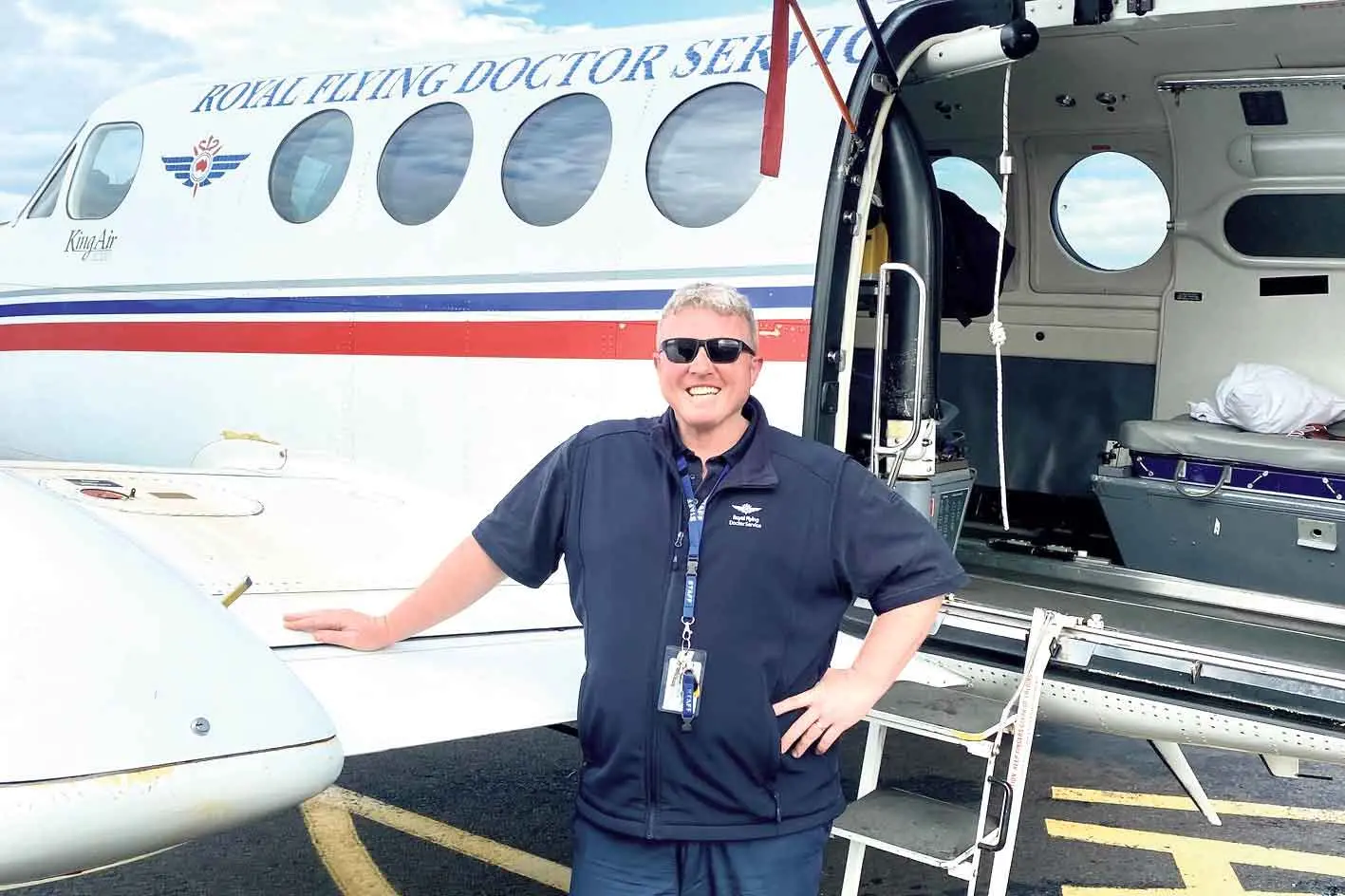
For Michael Cook, known as “Cookie” across the Royal Flying Doctor Service (RFDS) South Eastern Section (SE), midwifery is not just a speciality he practices and teaches on the job, it is woven through almost every part of his life.
Now in his 13th year with the RFDS SE, flight nurse and educator Cookie retrieves patients from some of the most remote parts of NSW. Like all RFDS SE flight nurses, he is dual‑qualified in emergency medicine and is a registered midwife.
For pregnant patients living hundreds of kilometres from a major hospital and maternity care, flight nurses may be the only ones with the midwifery skills they need. They are prepared to assess labour, manage complications, support mothers and babies, and make rapid decisions about whether to stay, move or escalate care.
“In rural and remote areas, there often isn’t a maternity unit just down the road so midwifery skills are essential. You need to be able to look after women safely, no matter where you are,” Cookie says.
That preparation has led to some memorable moments in Cookie's career. Flying with a pilot and retrieval doctor to retrieve another patient, a woman presented to hospital in early labour and with weather conditions deteriorating, the decision was made to bring her onboard.
As the aircraft approached Dubbo, it became clear they would not land in time.
“We put the plane into a holding pattern and just flew round and round,” Cookie recalls. “Everyone knew what their role was.”
At around 6,000 feet, circling above Dubbo in turbulent weather, a healthy baby girl was born. The pilot particularly enjoyed telling air traffic control that their passenger count had increased by one mid-flight!
Those skills have followed Cookie home as well, although never by intention.
Cookie and his wife Lucy have four children. He was present for the birth of all of them and, partly due to his midwifery experience and his wife’s uncommonly fast labours, he delivered three of them – at home waiting for the emergency services to arrive; in the safety of the hospital room; and even with help from his eldest daughter.
Their last child, born in 2017, arrived far quicker than anyone predicted. When labour progressed rapidly in the early hours of the morning, Cookie immediately called 000 and requested an ambulance while preparing to manage the birth until help arrived.
“I knew things would probably be fine,” he says.
“But part of being a clinician is knowing you always need backup. I wanted to know in case something went wrong, that someone was coming.”
The baby was born safely at home just before paramedics arrived, in a situation Cookie is careful to describe as “managed”, not ideal.
“These situations only work because I have extensive training and experience,” he says.
“They’re not something you aim for.”
That night also included a moment Cookie will never forget. Their eldest daughter woke and came into the room. Over the years, Cookie had spoken to his children in age‑appropriate ways about what labour looks and sounds like, explaining that it can appear confronting but is often a sign that everything is progressing normally.
“She wanted to be part of it,” he says.
As the baby was born, Cookie guided his daughter’s hands with his own.
“She was the only one I hadn’t delivered, so it felt right that she was part of the last one.”
Today, Cookie splits his time between flying retrievals, educating new flight nurses, and supporting midwives in local hospital birthing units. He has worked casually in maternity services in Dubbo for more than a decade and mentors graduate midwives alongside his RFDS role.
“My RFDS training doesn’t just affect one person for one year,” he says.
“They have a ripple effect across communities.”