
PHOTO
Australia’s next generation of sporting talent is increasingly looking beyond the traditional football codes and cricket, raising questions about whether government funding, community facilities and development programs are keeping pace with the changing interests of young Australians.
While soccer, rugby league, rugby union and cricket benefit from established club networks, high-profile professional competitions, corporate sponsorship and government investment, a growing number of other sports are competing for facilities, financial support and opportunities to develop their junior athletes.
The challenge is particularly evident in regional NSW, where smaller populations, limited sporting infrastructure and the cost of travelling to competitions can make pursuing a less mainstream sport considerably more difficult.
Almost 3.5 million Australian children aged 14 and under participate in organised sport outside school hours each year, according to Australian Sports Commission AusPlay data collected between July 2025 and June 2026.
Ensuring those children have a greater choice of sports, regardless of where they live, could also help keep more young Australians physically active as they progress through their teenage years.
Basketball struggling to keep up with demand
Basketball is one of the clearest examples of a sport enjoying strong popularity but struggling to provide sufficient facilities.
Basketball NSW recorded 89,441 registered participants in 2025, while its Sporting Schools program reached almost 55,000 students across 400 schools.
The organisation estimates NSW will need more than 330 additional indoor courts over the next decade to accommodate existing and future demand. Some associations are already being forced to shorten games, increase team sizes or turn prospective players away.
Basketball NSW has previously highlighted the need for additional facilities in Dubbo following the loss of pledged funding for the proposed Western NSW sports hub. However, a spokesperson for NSW Sport Minister Steve Kamper told the ABC in April that the government had committed $32 million to basketball facilities or multi-use venues incorporating basketball since coming to office in March 2023.
Additional indoor sporting facilities could also benefit volleyball, badminton, futsal and other sports competing for limited court space.
Volleyball and emerging Olympic sports
Volleyball is another sport experiencing rapid growth. In October, Volleyball NSW reported participation had increased by more than 150 per cent over five years, with about 10,500 registered members and more than 60 affiliated clubs.
The sport is attracting participants from diverse cultural backgrounds, with members representing 104 nationalities.
The Olympic Games are also helping introduce young Australians to sports that previously received relatively little mainstream attention, including sport climbing and flag football.
Flag football, a non-contact version of American football, will make its Olympic debut in Los Angeles in 2028.
An introductory program involving 10 Queensland schools in 2022 had since expanded to 750 schools nationwide, supported by investment from America's National Football League.
The sport offers another competitive pathway for young Australians, particularly those with experience in touch football and OzTag.
Country kids chasing different sporting dreams
Away from conventional sporting fields, junior bull riding is developing its own national and international pathways.
The PBR Australia Can-Am Junior Academy Grand Finals, held in Tamworth in October, offered $29,000 in prizemoney and end-of-season bonuses, which organisers described as Australia's richest junior bull riding finals.
Among the leading contenders heading into the finals were Dubbo's Taelyn Brown, Two Mile Flat's Smiley Butler and Orange's Blake Abbott.
PBR Australia managing director Glen Young said the academy had developed into a genuine national pathway.
"The growth of the Junior Academy has been extraordinary. We're seeing young riders travel from every corner of Australia to compete, and this year we've even had young New Zealand riders coming across the Tasman to test themselves against our best," Mr Young said.
While the sport presents distinct safety and animal welfare considerations, its development highlights the diversity of sporting interests among country children and the distances families can travel to support them.
Search interest in up-and-coming sports
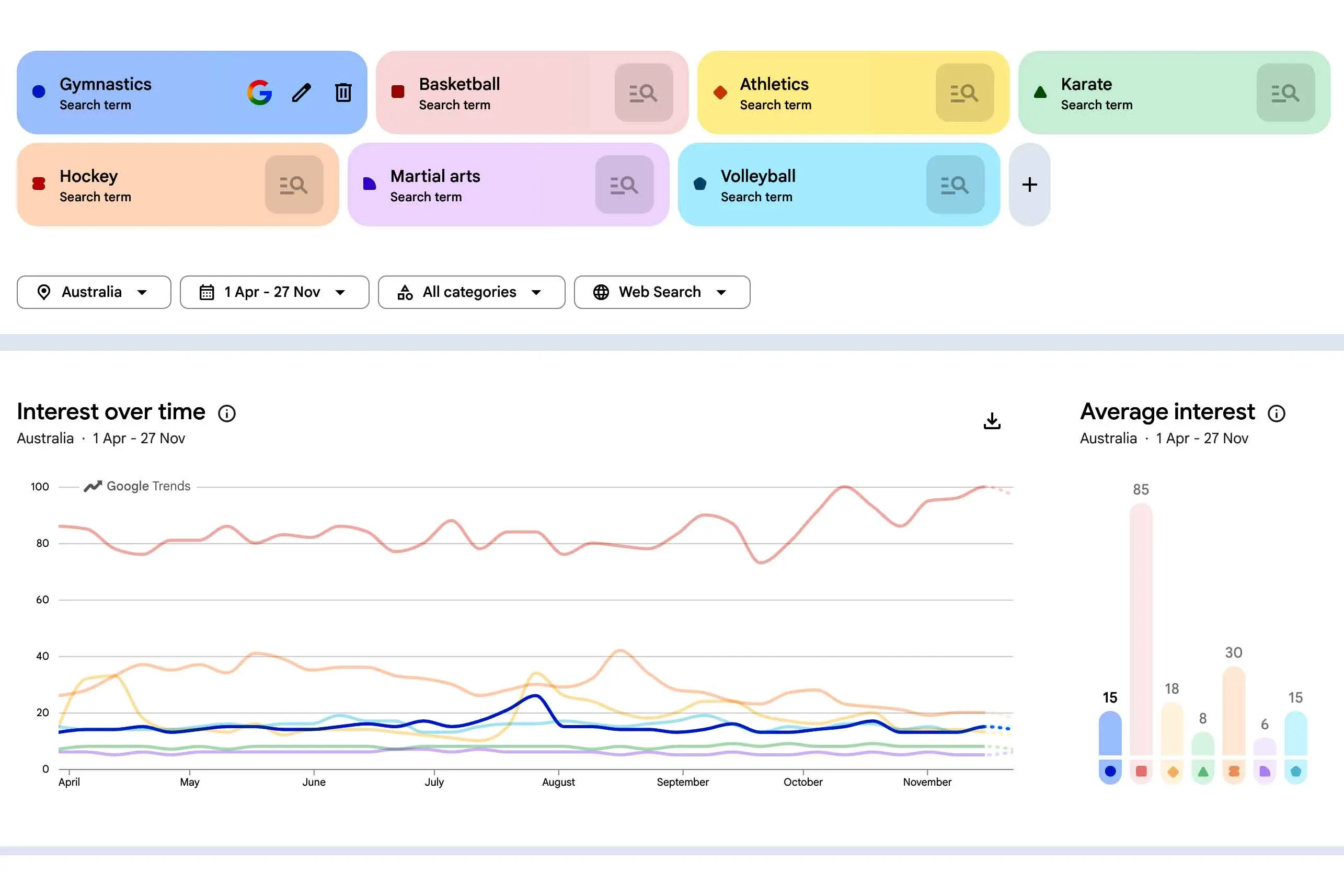
Basketball is one of the leading sports attracting interest from Australians looking for alternatives to rugby league, union, cricket and soccer. Google Trends data shows strong search interest in basketball over the past ten months, with an uptick in interest since mid-October.
Hockey is relatively well served in regional NSW, compared to some emerging sports, with dedicated facilities and an organised competition in Dubbo, as well as fields in Molong, Parkes and Orange. Search interest in the sport has also been strong this year, Google Trends data shows, surging during July and August which is traditionally when the season is drawing close to finals time.
Amongst the other secondary and emerging sports analysed by this masthead, gymnastics, karate, athletics, volleyball and pickleball all enjoyed significant interest across Australia, with gymnastics and athletics in particular enjoying a surge in search interest during the winter months of 2026, according to Google Trends data.
Government funding supporting alternatives
There are encouraging signs that government funding is reaching beyond traditional sports.
At the end of July, the NSW Government announced $500,000 in funding for 19 projects across 16 sporting organisations under its Play Her Way Innovation Program, aimed at attracting and retaining women and girls in sport.
Motorsport Australia received $45,000 for school programs, mentoring and a regional rally school to encourage female participation.
Triathlon NSW received $45,000 to establish a digital sporting community for young women aged 16 to 25, while Volleyball NSW received $45,000 to support female coaching and leadership development.
Further regional funding announced in early November included $310,010 for Cobar's multi-sport courts, $239,764 for youth participation and swimming pool initiatives in Ivanhoe, and $89,542 for junior tennis and facility improvements in Broken Hill.
Making junior sport more affordable
Funding sporting organisations and facilities is only part of the equation.
Research commissioned by the Australian Sports Commission and released in August found the average entry-level cost of participating in sport for children was $1161, including registration, clothing and equipment.
Travel and accommodation can add considerably to those expenses, particularly for regional families.
Keeping sport enjoyable is equally important. Australian water polo representative and Olympic silver medallist Sienna Hearn highlighted the importance of positive junior sporting experiences when supporting the NSW Government's Shoosh for Kids campaign.
"Junior sport has given me some of my best memories," Hearn said.
The challenge for future funding decisions will be balancing the legitimate needs of established sporting codes with those of smaller and emerging sports.
Participation growth, waiting lists, geographic disadvantage, affordability and the availability of existing facilities could all help determine where additional public investment would deliver the greatest benefits.
For children who have little interest in cricket or traditional football codes, having an accessible and affordable alternative could make the difference between participating in sport and giving it away altogether.
* This content is part of a paid partnership with Google to promote Google Trends.