
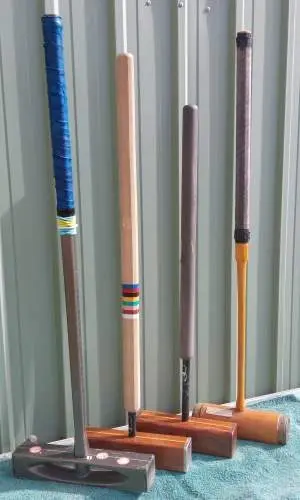
PHOTO
Contributed by “South Stake”.
An essential piece of equipment for any croquet player is, of course, their mallet. The rules around mallets are quite straightforward, however, certainly when contrasted with the strict requirements around, say, baseball or cricket bats, for example.
A mallet consists of a head with a shaft which is firmly connected to the mid-point of the head. The shape and dimensions of the head, are not stipulated.
The attachment between the shaft and the head must be at right angles for at least the bottom 12 inches (30.27cm). This ensures that they function as one unit.
Alternative but equivalent arrangements are also permitted, provided that the playing characteristics of the mallet do not depend on which end-face is used to strike the ball.
A player with a physical disability or impairment, however, may use a mallet with an appropriately-modified shaft or artificial aids, provided that there is no unfair advantage.
A recent visitor to the Dubbo Club had a mallet shaft that formed a pronounced “V” shape at the grip end. This modification was to accommodate significant arthritis in his hands and wrists.
Permissible adaptations do not extend to having a mould of the player’s hands fitted to the grip, however.
The head must be rigid and may be made of any suitable material. There must be equal playing characteristics, regardless of which end is used to strike the ball.
A player cannot exchange the mallet for another during a game unless it has been significantly damaged during play.
The weight of the mallet is not stipulated, nor is the length of the shaft, or the dimensions and shape of the head.
As a rough measure, the shaft length is commonly found to be the most comfortable for the majority of players, if it matches the distance from the player’s waist to the ground.
A very common combination is for the shaft to measure 36 inches (91.4cm), and for the total weight to be about three pounds (1.36kg).
Any combination of shaft lengths, total weight, head shape, and dimensions are allowable though, providing it all falls within the generous limits of the rules.
Our Club owns mallets ranging in shaft length from 31 to 42 inches, and weighting from two pounds and eight ounces to three pounds and four ounces. Other lengths and weights are permissible.
The largest maker of croquet mallets in the world is actually a New Zealand family company, Wood Mallets. This brand is the only one endorsed and stocked by Croquet England, which is considered the premier authority for the sport.
Apart from initial cutting, all work for each mallet is done by hand. Despite this bespoke approach, strict quality monitoring and control are followed. Other makers tend to have a similar approach.
The PFC HoopMaker is entirely machine made from Spring Alloy. In 2024, it was rated in the top five of quality mallets.
The Dubbo Club owns many Wood Mallets, and a selection of mallets from Australian makers as well. Players are free to make their own, in line with the regulations.
A mallet can be tailored and matched to the preferences and characteristics of its mate. So here, in yet another form, we see that croquet has something for everyone.