
PHOTO
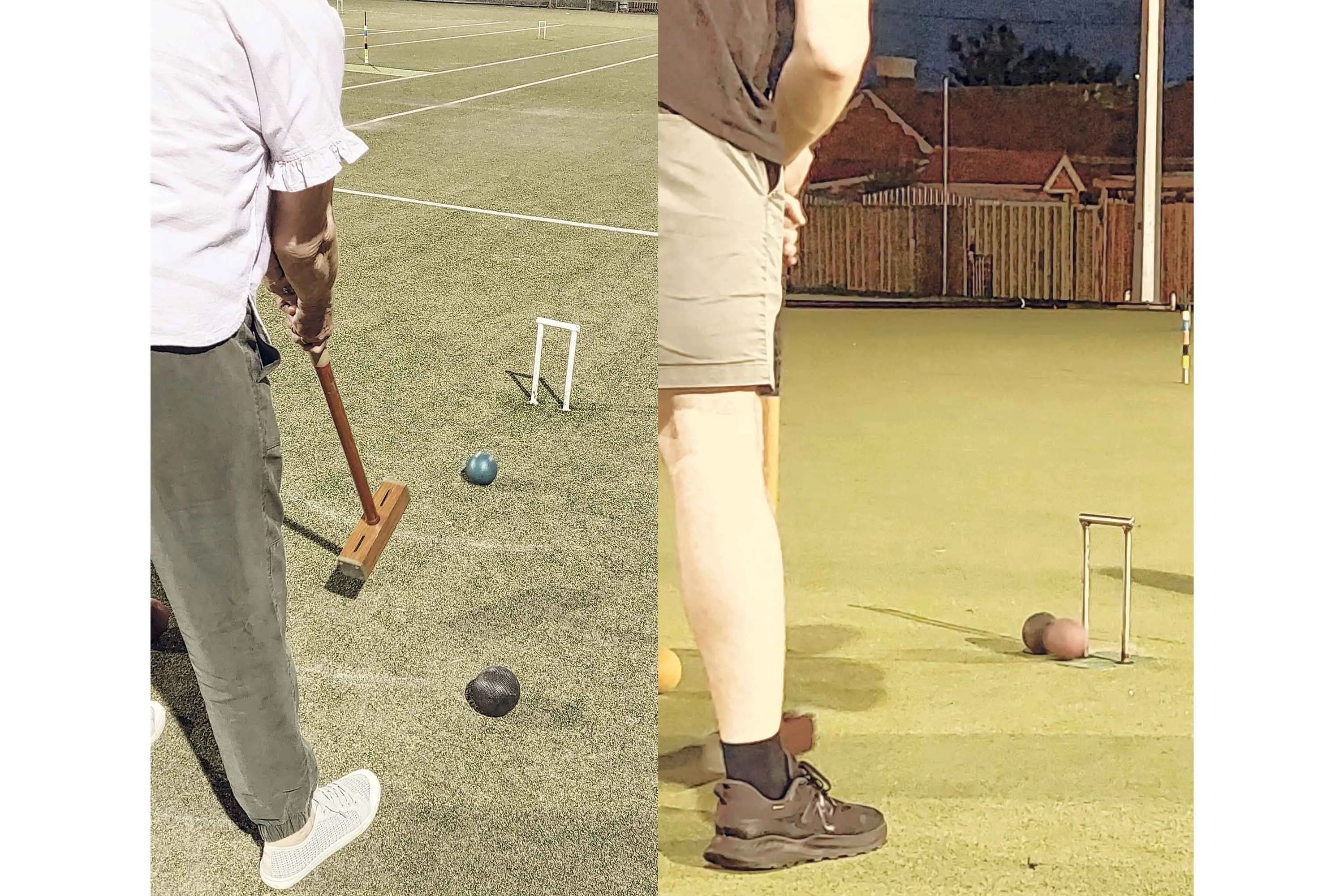
Aim of the game in croquet is to hit a ball through a metal hoop with a mallet. Seems straightforward, but the ball is wide and the hoop is narrow. Still achievable, right?
Being able to hit your ball so it ends up in an advantageous position, preparatory to running the hoop, is a highly valued skill. One can’t expect to run the hoop from extraordinary distances.
So, get in position, then hoop. Sounds simple, unless you realise the width of the hoop is 3.0875 inches. That probably means absolutely nothing to most people, as croquet still uses Imperial measurements.
For anyone under 60, 3.0875 inches is a bit over 7.84 centimetres. With the diameter of a ball 3.725 inches (9.4615 mm), that’s a gap of only 7.8 mm... less than the width of a pencil!
Of course, if an opponent’s ball is also in the way, or is likely to score the hoop first, it behoves the canny player to hit the wretched thing away (“roquet”). Preferably, far away but, depending on the situation, just a nudge might be enough.
Hitting a partner’s ball into a better position during the game would be a cunning ploy. Being able to hit your ball into the optimum position (“placement”) is the most commonly required skill. Placement is putting your own ball where you want it to stop. This requires skills of accurately making the distance and judging with precision the angle at which the shot is played.
Being able to hit another ball with accuracy to achieve the optimum placement of one’s own ball, while being able to place the struck ball to a place which most benefits one (and one’s partner), and simultaneously, inflicts most damage to your opponent, follows.
Hitting a ball so that it scores the hoop (“hooping”) is essential, because achieving this is the aim of the game but it is actually the least-used stroke.
So, there we have it: roquet, placement, hooping. Everything else, is just brain power!