
PHOTO
What can you tell us about yourself? I think the Poem “The Camera Man” by Riverbank Frank Doolan is a good way to start my story.
Uncle Merv Bishop
You’re such a special man
You’re the one who took the picture
Known right across the land.
You know the one I mean
That moment in Time
That captured our Black History
You’re a Hero of mine.
Hey, Brewarrina boy
You have done your people proud.
You’re a Black Superstar
Who has never acted loud.
I don’t think we celebrate Merv Bishop
The way we really should
You’re a standout, Uncle Merv
You’re humble, yet so good.
Documenting lives
Just snapping away
Recording the life stories
Of our people and our ways.
I just want to tell you, brother,
That I carry you in my heart
There are many great photographers
But you’re a man apart.
- By Riverbank Frank Doolan, February 26, 2016.
•••
I was born in Brewarrina in 1945. My mother worked in a hotel and my father was a shearer and a shearers’ cook. My mother loved to take photographs. She carried her camera everywhere. I used to sneak away with her Kodak Brownie camera to take photos.
When I was 10 years old, I met a grader driver in Brewarrina who used to develop photos in his home dark room. I was hooked straight away. I just loved the smell of the chemicals and the watching the image appear in the developer. Little did I know this love would lead me to becoming the Australia’s first Indigenous news and documentary photographer.
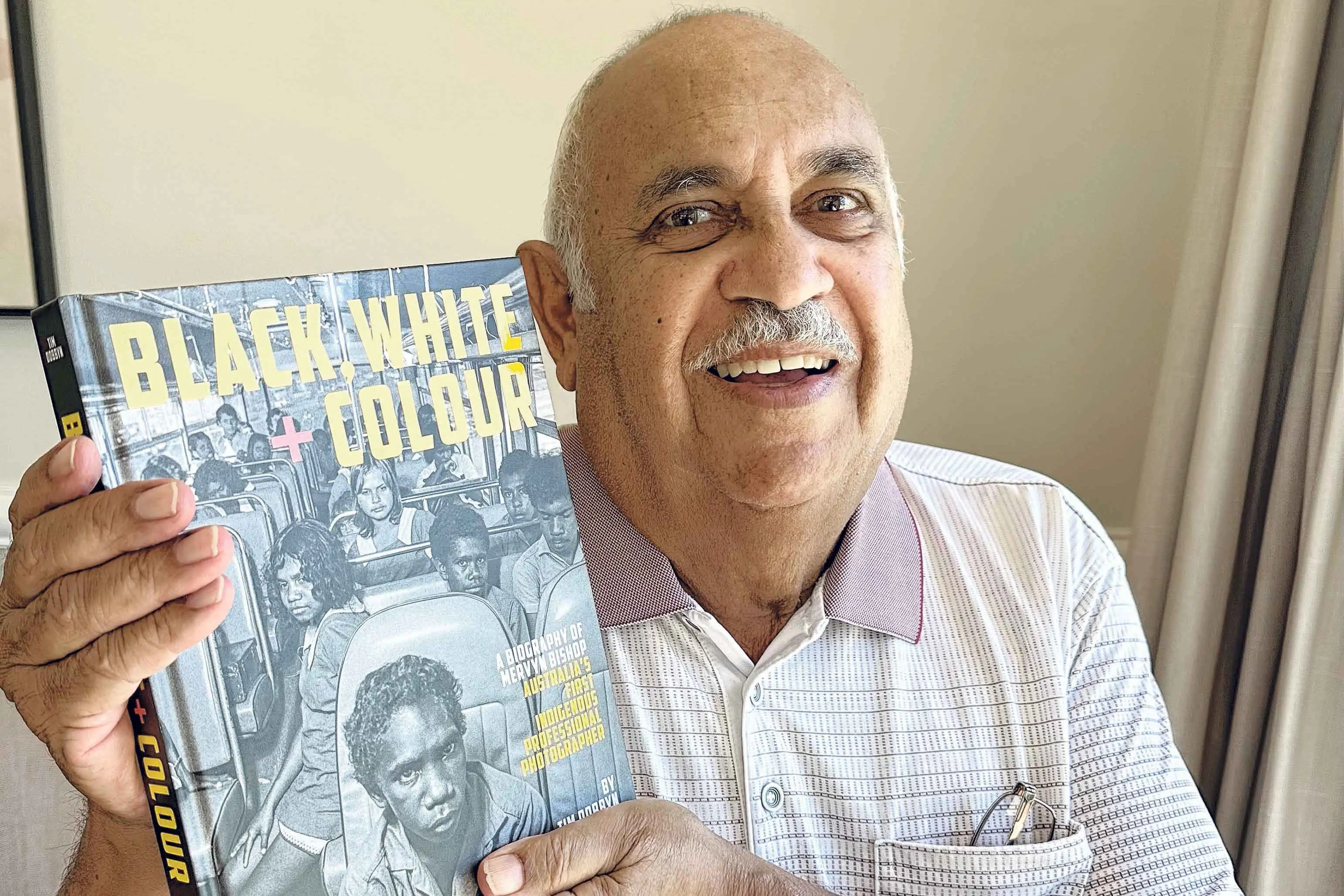
What are you looking forward to? At 80 years of age, I’m celebrating the publication of my biography “Black, White + Colour” by Tim Dobbyn, and the exhibition of my photos and life at the State Library of NSW in Sydney.
Next week we are holding a book signing for “Black, White + Colour” at Snare’s Newsagency, Talbragar Street, Dubbo on Thursday, March 19, from 10am to 2pm. Tim Dobbyn’s father was a sub-editor on The Sydney Morning Herald and had organised funds to help the education of an Aboriginal child. I was nine at the time and wrote to the sub-editors to say thank you. I met Tim Dobbyn and his family in person when I moved to Dubbo to start high school. Tim and I have known each other ever since. The book is an illustrated biography telling of the struggles and triumphs throughout my life.
When did you come to Dubbo? I came to Dubbo in 1960. Dubbo High was the only full high school in Western NSW until the early 1970s, so students came from Cobar, Bourke, Brewarrina and north to the Queensland border. We used to travel to Dubbo on the steam train, and I lived at the Anglican Church Boys’ Hostel.
In 1963, at 17, I went for an interview for a cadetship at The Sydney Morning Herald, and I showed some of my slides on a lightbox. In the 1960s and 1970s I photographed so many people from Roy Orbison, Mick Jagger, Barry Humphries and of course, Gough Whitlam and Vincent Lingiari.
In 1970 I married my wife Elizabeth, and a few years later we moved to Canberra where I started a job with the Department of Aboriginal Affairs. Our son Tim and daughter Rosemary were only young when Elizabeth died. Rosemary was five, and she eventually came back to Dubbo to live with my sister, Cynthia. I’m living back in Dubbo now.
What do you love doing? I don’t pick up a camera as much anymore. I use my phone now to take photos of the grandkids. I do love yarning with all sorts of people. I love to have a chat. I’ve also always been a golfer. I haven’t played as much in the last few years with a few medical issues, but I want to start again. The golf club hold a trivia night once a month on a Friday night and I love seeing all the golfers and catching up with everyone. The trivia night supports the Royal Flying Doctors, so it is all for a good cause.
What’s next? I’m off to Melbourne for interviews about the book in the next month or so. Then to Sydney to the Exhibition. I’m hoping to move back into my little house soon. It’s getting some work done. Lots of travelling about and having a chat!