
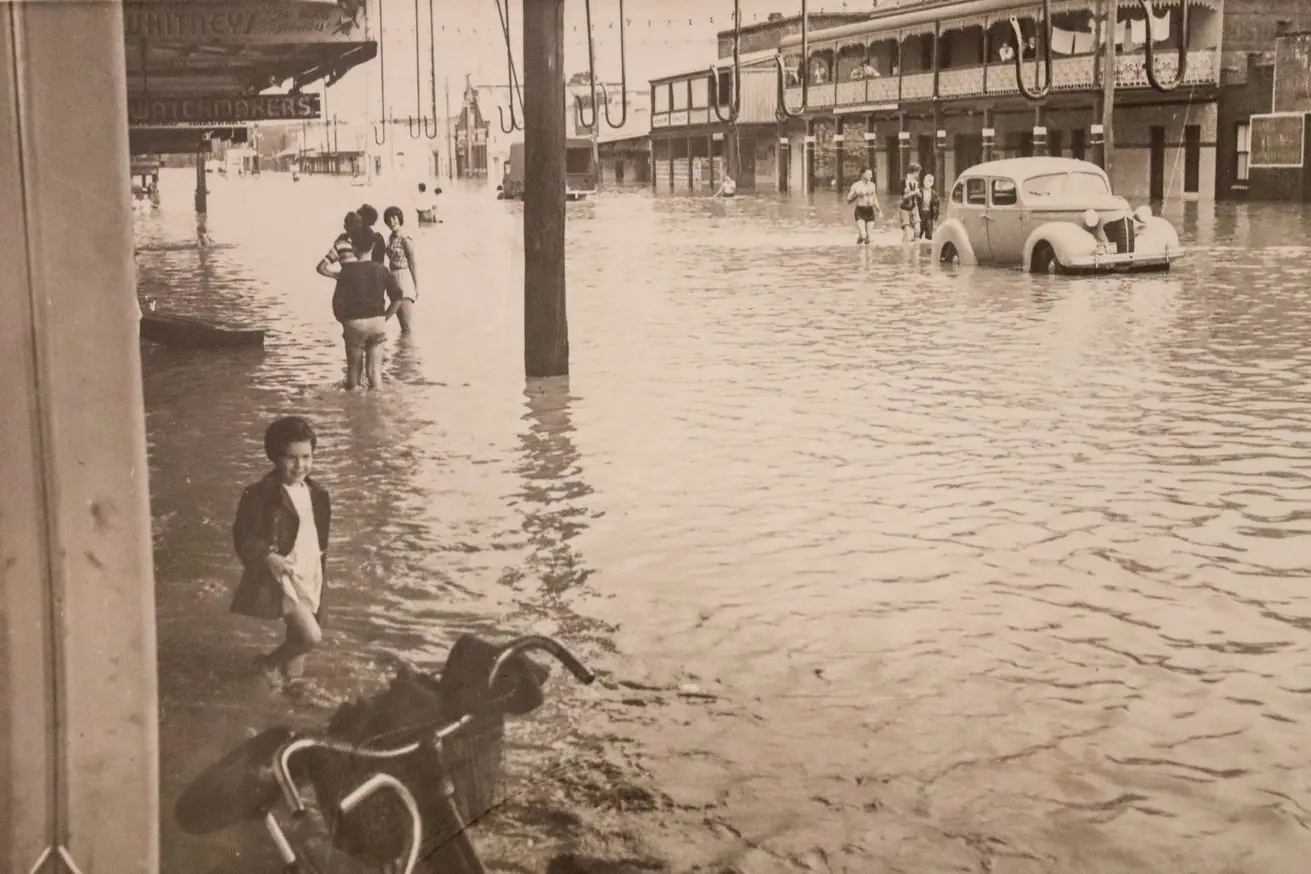
PHOTO
An anniversary quietly ticks over this week as the region remembers and reflects on a major natural disaster that swept across central and northern NSW, and gave birth to what we now know and appreciate as the State Emergency Service.
In late February 1955, major flooding impacted the central west and swept right across the Hunter Valley to the coast, causing the death of 25 people and widespread destruction.
Locally, the Talbragar and Macquarie rivers rose quickly in the last week of February 1955, from what has been described as a period of “monsoonal rain”.
The Talbragar River reportedly created a “dam-like” effect on the Macquarie River, inevitably spilling over onto the surrounding land, and into the then country town of Dubbo in the early hours of Friday, February 25, 1955. Other local rivers were also impacted.
While the waters did recede fairly quickly, the central business district and north Dubbo were significantly affected for several weeks.
To get an idea of just how high the water rose back then, a plaque outside the Shakespeare Funerals and Monuments building in Talbragar Street memorialises the historic event.
Wellington also was flooded, but not to the same degree as Dubbo. Locally, the fast-flowing Bell River rose and floodwater entered part of the central business district.
The NSW State Emergency Service was formed in the months after the 1955 flood and also commemorates its 70th anniversary this year. Local SES units are expected to be involved in different commemorative activities around the state throughout 2025.
The Burrendong Dam was finally completed in 1967, some 21 years after construction first began. It has been credited with preventing further catastrophic flooding in the years since.
Seventy years on, ‘The Big Flood’ is still a defining moment of history for Australia, and certainly, for local communities in the central west who lived through it.
The Dubbo Photo News spoke to a number of people and organisations about the local impact of the 1955 flood. Our sister publications in Gilgandra, Warren, and Narromine will also reflect this week on the impact of the that event in their communities.
Library resources capture flood story
Helen Thompson, Resource Librarian at the Macquarie Regional Library in Dubbo, showed the Dubbo Photo News several original and very precious historical resources from the time, including original newspapers that chronicled how locals fared during and in the aftermath of the local floods.
“They do get brittle, and we have the [originals] on microfilm,” Helen explained.
The library itself, on the corner of Macquarie and Talbragar Streets, sits on the site of what used to be Paull’s Service Station. A blown-up black and white photo of the site well under water from the 1955 flood adorns the wall of the library’s local history storage room.
“The flood was lapping right up into Victoria Park,” she said.
The library has a collection of 75 digitised photos of the 1955 flood on its catalogue. It also has excellent resources such as the late regional history writer Marion Dormer’s definitive book, “Dubbo: City on the Plains 1901:1988” which makes several references to the 1955 flood.
“The rivers built up all day and finally the flood broke at night time when shops and business premises were closed and many people were asleep,” Ms Dormer’s book reveals.
“Not one business or shop in the whole stretch of main shopping centre Macquarie, Talbragar, Brisbane and Church Streets missed being flooded.”
The flood struck Dubbo around 2am on Friday, February 25, 1955, with blackouts occurring as water engulfed the local electricity station.
“It all happened so quickly – so many stories of dramatic rescues could be told and so many people were involved that it is possible to record only fragments of that momentous event in Dubbo’s history,” Ms Dormer’s book states.
The Macquarie Regional Library will have a small photographic display about the 1955 flood available for viewing around the anniversary, Helen said.
The library also has an online oral history project that chronicles several residents’ personal reflections of the 1955 floods. Readers can access this via the library’s website.
The Western Plains Cultural Centre also has a local history room with similar historical resources to the library. Residents keen to walk down memory lane should contact the Dubbo Regional Council to make an appointment to speak with local history officer, Simone Taylor, about available resources.
Helen McLean, Dubbo: “An exciting adventure!”
One of those featured in the Macquarie Regional Library’s oral history project is Helen McLean, now 77, who sat down with the Dubbo Photo News recently to talk about her experiences living through the 1955 flood. Her parents, John and Audrey Goss, owned a popular bakery in Talbragar Street next to the Pastoral Hotel.
“The water actually came up six feet through our bakery,” Helen, a popular local civil celebrant, recalled.
“Dad was running around and in and out in a little rowboat.”
The flood was a big adventure for Helen, then just eight, who lived with her family above the bakery. When the flood hit in the middle of the night, the bakery’s wood-fired brick ovens were completely destroyed.
“All the doughs had been set, the bread was all in the ovens, and then [the flood] started,” Helen said.
“All these loaves of bread were floating past in their pans,” she recalled, indicating some ended up in the floodwaters out in the street.
“Free deliveries!” Helen laughed.
The family relocated, reluctantly, to a house in Fitzroy Street that was out of the flood-affected area, where they stayed for three months.
The children of the time thought the flood was a big adventure, Helen said.
“We thought it was wonderful and exciting, you know, but, but it was probably because of our age that we were thinking this was just a big, exciting adventure.”
Helen said her parents were devastated by the loss of their business.
“The brick ovens all collapsed and my parents thought, how do we get past this?” she said.
“My dad was a person who always helped others, especially people who were hungry. He always gave to everybody. So now it was his turn to ask for help.”
Help came in the form of the local fire brigade, who turned their big hoses on after the waters receded and washed all the mud away from the bakery.
“They were wonderful,” Helen said of the fire brigade.
“And Dad said, well, let's just try again.”
The Goss family were able to find a silver lining amid the incredible devastation to their livelihood. The family rebuilt their business after the flood but upgraded and installed electric ovens which proved to be a very good business decision.
John Leach, Dubbo: “North Dubbo decimated”
John Leach was roused from his sleep by his mum when the flood hit Dubbo in the early hours of February 25, 1955. The young man and others had been monitoring the water rising and predicted it wouldn’t hit until the next day.
“‘Quick, quick, you’ve got to get up!’ she said, relaying a message to me from a mate,” he added.
“‘He wants you to get up the depot to get the truck, because the Commercial Hotel is being flooded in the basement,’” John, now 93, recalled his mother’s words.
He promptly jumped on his pushbike and headed for the fuel depot where he worked, having to navigate the rising water in different central business district streets to get to the Commercial Hotel.
“What caused the flood was that heavy rain, a lot of rain. We had about 10 or 11 inches here, and was that over just 24 hours,” he said.
“We found out later that the Talbragar River caused the problem. It became a weir and water backed up against that,” he added.
John said the flooding only impacted the area immediately around the river and north Dubbo. “Because the water banked up through north Dubbo, that's why it decimated the poor people that owned houses and businesses over there,” he said.
“The lowest part of town is the police station and it got flooded, and the courthouse,” he added.
John recalled assisting a police officer in a memorable rescue of an elderly lady dressed in black, standing in floodwater in Erskine Street.
“Back in those days, the old ladies used to wear long black dresses, and she'd been standing in the water from about three o'clock in the morning, so 12 hours waiting for help,” he explained.
When the lady refused to leave, however, the police officer politely said he would have to arrest her.
“She wasn’t very big, and he plucked the poor darling out of the water and into the boat,” John laughed at the memory.
John’s sweetheart and later wife, Thurza Tipping, had a hairdressing salon near what became the Snare’s newsagency, and it was inundated in the flood. He helped her clean up the mess afterwards, and they married in 1958, going on to have a long and happy life together and raising two children.
Ron Jones, Wellington: “Not much to see here”
Wellington local Ron Jones, 85, told the Dubbo Photo News that while the town did flood in 1955, more damage was experienced the following year when the fast-flowing and often fickle Bell River burst its banks yet again.
“Hardly anyone got flooded here in 1955,” Ron said.
“A few houses down near the Bell River, the flats got flooded, but very few. A couple of houses in the town too,” he added.
“[The floodwater] didn't go through the shops in Nanima Crescent, but right up to the door. They had sandbags in there, opposite the Commonwealth Bank.”
Then a teenager, Ron remembers riding his pushbike around the town with his mates, and in 1955 the flood wasn’t really considered a big deal.
He recalls one fellow being rescued from his refuge up a tree by people in rowboats.
The Wellington Museum has a small collection of photos from the 1955 and 1956 floods. Museum volunteer Ruth Cosier kindly showed the Dubbo Photo News the collection during our visit.
A famous photo from February 1955 shows local lasses Carmel Larum and Pauline McGarrity in a boat on one of the flooded local streets.
While the Wellington Museum doesn’t currently have an oral history collection like its Dubbo counterpart, Ruth hopes this might become a project for the future to help preserve local stories from the past like those shared by Ron Jones.
Housed in the old police station (adjacent to the new one), the Wellington Museum is open Friday to Sunday.
1955 Flood: Politicians reflect
Many lessons were learned from the 1955 flood disaster, something local elected representatives across the levels of government were keen to stress when reflecting on the 70th anniversary of the event.
“Seventy years ago, our city faced one of its greatest challenges through an unprecedented disaster when flood waters peaked at 12.67m, flooding large areas of Dubbo including the main business district,” said Dubbo Regional Council Mayor, Josh Black.
“The historic flood, known as the city’s biggest, tested the strength and resilience of the community back then. Today we remember not just the devastation, but the spirit of those that rebuilt our CBD and led to the planning and provisions we have in place for the city now,” he added.
Historic flooding events like the 1955 event, and those since, have served as vital lessons for the future, Mayor Black stressed.
“Council remains committed to ensuring that all new developments in the Dubbo Region carefully consider flood risks,” he said.
“We continue to balance economic, environmental, social, and safety considerations while working to minimize both the impact of flooding on development and the impact of development on flooding.”
State Member for Dubbo, Dugald Saunders MP, represents a State electorate that experienced significant inundation during the 1955 flood, something he hopes the community will never see again.
“The 1955 flood is still remembered by many, as water levels reached the highest level in Dubbo's history,” Mr Saunders said.
“The memories will remain and be documented forever, but I'm hoping we never see that scale of flooding again,” he added.
“As we reflect back on that time 70 years ago, there are still challenges, but also opportunities.
The new Dubbo bridge will provide one of the greatest opportunities for the city since that 1955 flood, and I'm excited about the difference it will make to the region,” he concluded.
Retiring Federal Member for Parkes, Mark Coulton MP, presides over one of the largest federal electorates in the country, measuring 393,413 square kilometres.
Mr Coulton was also approached earlier this month for comment about the 70th anniversary of the flood disaster, which severely impacted the Parkes electorate. However, the Dubbo Photo News understands Mr Coulton is on leave, and did not receive a response.