
PHOTO
Buddha in the bush and a thousand miles from care, the quiet rural location south of Dubbo, seems the most unlikely spot for a Tibetan monastery.
However, in another sense, it is very appropriate for a religion based on peace, meditation, and tranquillity. Yet its choice of location was no accident: Its original missionaries in 2004 apparently knew it was just what they were after.
“I think the founders had an intuitive sense about this place,” monk Lama Chewang Norbu Bhutia said.
“It was just what they were looking for, an ideal place to meditate, and to learn."
Popular with adherents and curious outsiders who have attended retreats and various courses at the facility over more than two decades, it is certainly not your typical country experience.
The Karma Yiwang Samten Ling centre, sister to the study centre and shop at Wellington, is nestled in a quiet valley along a dirt road amongst working local farms.
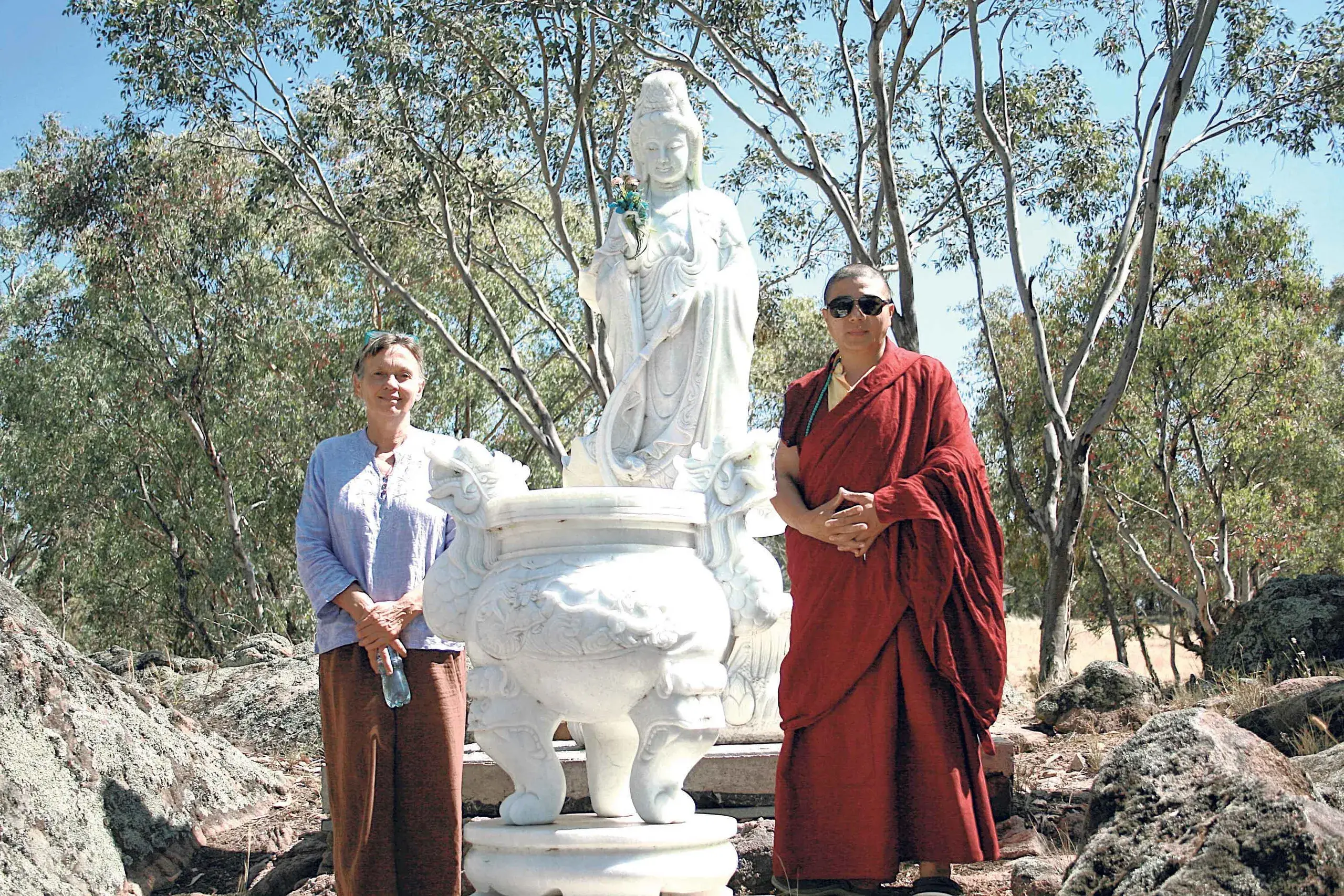
Volunteer Rosie Aguila and Lama Chewang recently invited Dubbo Photo News to the 86-acre property for a quick look around and a chat.
While an exotic temple, stone lions, and statues amongst the scrub may seem a touch incongruous, Buddhism is actually our fourth largest faith group; a growing religion with more than 615,000 adherents in Australia.
While much of this is directly due to immigration from countries with high native populations — including Thailand, Vietnam, China, Sri Lanka, Cambodia, Nepal, and Laos — many new adherents are also home-grown Aussies, as can be witnessed by attendees at the courses run regularly at the monastery’s sister facility at Wellington.
One such individual who found the teachings of the fifth century BC Nepalese-Indian philosopher, Siddhartha Gautama — now known as Buddha, “the awakened one” — compelling, was Rosie, who volunteers and coordinates much of the events at the centre.
“I grew up at Moss Vale and went to Catholic schools all the way through but, when I was 15 or 16, I read a book ‘The Siddhartha’ which I really liked… but nothing much happened after that,” Rosie recalls.
“Later, when I was travelling in Thailand, I saw everyone stressing and hurrying, and then there were these Buddhist monks, and they were just so happy and not worried at all,” she added.
This, she explained, was the start of a lifelong vocation, a journey that eventually brought her to Boree in the Central West.
“I then started reading and became interested in it; the one thing I found most compelling, was the meditation. Buddha said, ‘Practice it, and if you don’t like it, move on; if you like it, continue,’ I found that fascinating,” Rosie said.
Non-compulsion, free choice, and learning how to master your feelings, are essential and somewhat unique elements of Buddhism, Lama Chewang explained.
“It is about studying how to live without hatred, to live with loving kindness and compassion. How to remove negative habits… Buddha taught us to try to do the best and to test oneself, and to live together peacefully and liberated from negative attributes of a toxic mind,” he revealed.
With a philosophy counter-intuitive to our hectic, fast-paced 21st century world, the monastery runs up to half a dozen retreats a year for those interested in learning more, or adherents interested in honing their Buddhist practices.
“They’re normally week-long events with dormitory accommodation that includes study, prayer, and meditation,” Rosie said.
“We have people attending from all over, Sydney and country NSW, Queensland Victoria, Tasmania, Melbourne, even New Zealand.”
With the site already featuring the Stupa of Reconciliation — a central symbol for the Tibetan form of Buddhism practiced at the monastery — a number of indoor temples and study centres, and the iconic Snow Lions that represent the wisdom and strength of Buddha, the facility is looking to grow.
“In 2026, we’re going to build two or three single unit facilities for people coming here who want to be alone,” Rosie revealed. “These will be for solitude, for people who are really serious meditators,” she emphasised.
Buddhism is often contrasted with the typical Abrahamic religions — Judaism, Christianity, and Islam — because of its emphasis on wisdom, knowledge, and insight, rather than faith, ritual, and adherence.
To emphasise this, Lama Chewang points to the flying emblems around the facility.
“We call them ‘Victory Flags’ because the wind blows away our negativity… their five colours, represent the Five Wisdoms (awareness, equality, discernment, beneficial action, and understanding),” he said, using the disposable drinking container between us, as an example of these.
“If we have no wisdom about this bottle, how can we know that it is drinking water?”